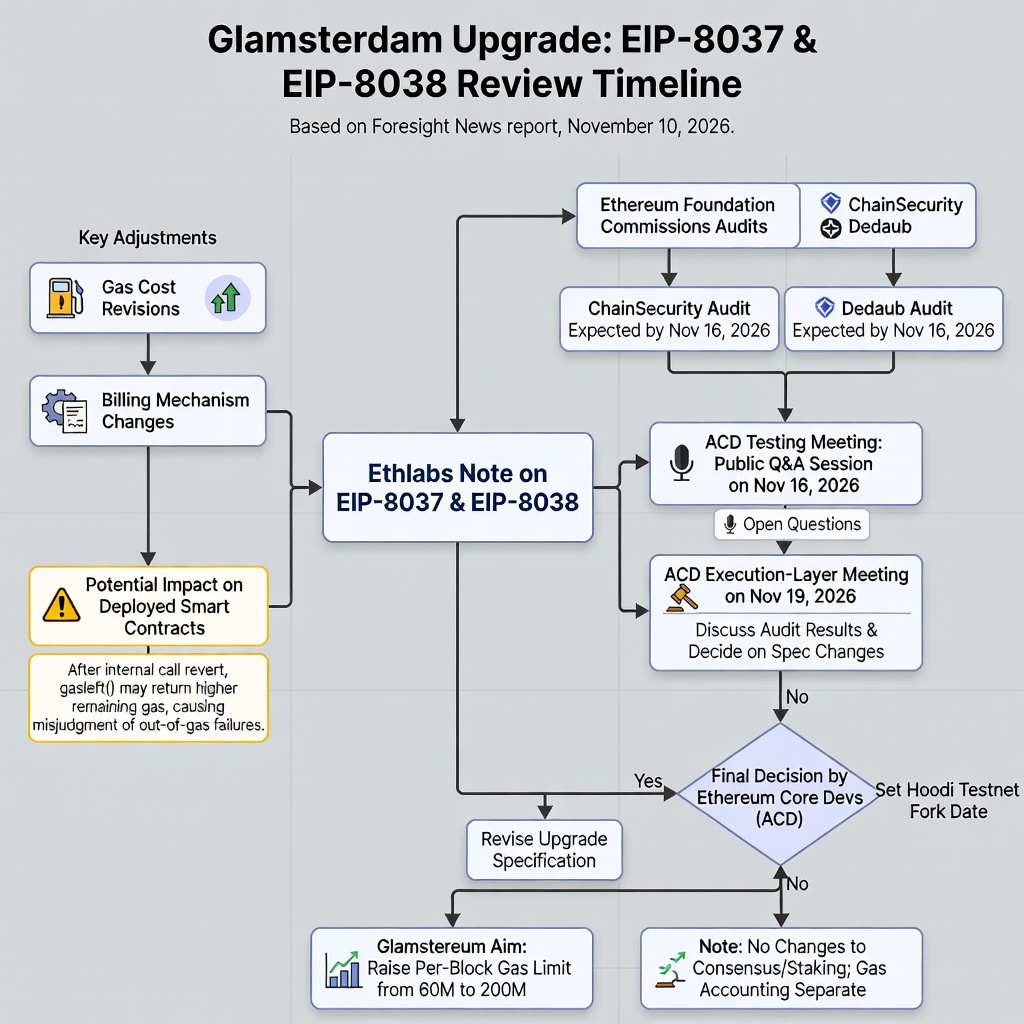
At 17:44 CST (UTC+8) on November 10, 2026, Foresight News reported that Ethlabs had published a note on EIP-8037 and EIP-8038, two proposals included in the planned Glamsterdam upgrade. Ethlabs said the proposals adjust gas costs and the billing mechanism, and that those changes may affect some smart contracts already deployed. Glamsterdam was not described as an activated upgrade: the specification and the Hoodi testnet fork date were still open.
Ethlabs recommended waiting until the external audit results are public and the impact is clear before either revising the upgrade specification or setting a fork date for the Hoodi testnet. The report said the final decision belongs to the Ethereum core developers’ meeting (ACD).
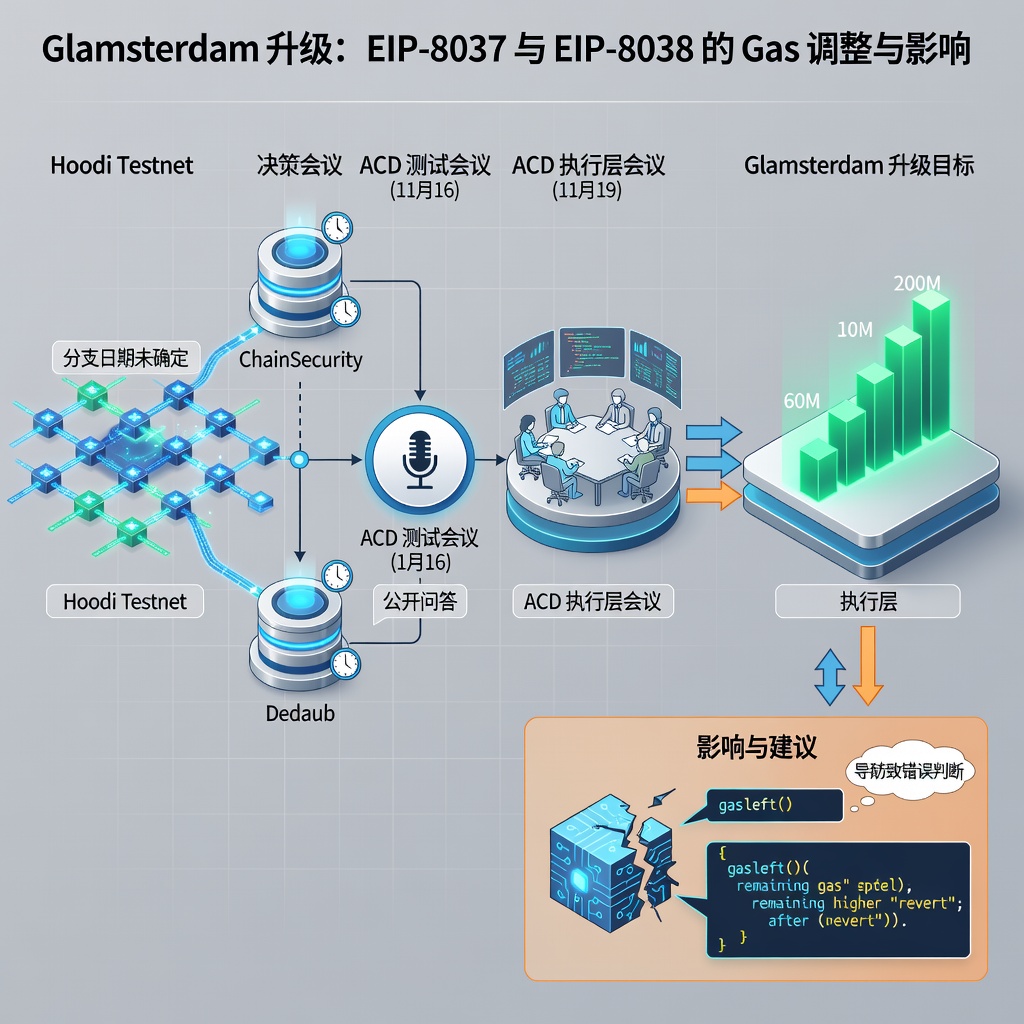
The Ethereum Foundation had commissioned two external audits, by ChainSecurity and Dedaub. As of the November 10 report, both were expected before November 16, 2026. On that same day, an ACD testing meeting was to hold a public question-and-answer session. The ACD execution-layer meeting on November 19, 2026 was expected to discuss the audit results and might decide whether to change the upgrade specification. The report did not say that either meeting had already reached a decision.
Glamsterdam’s stated aim is to raise Ethereum’s per-block gas limit from 60 million to 200 million. Gas is the execution layer’s unit for metering computation. That accounting is separate from consensus duties and from staking participation; the report did not describe a penalty or a slashing change.
Ethlabs said gas-cost changes can affect contracts and tools that hard-code the cost of particular operations. A change in billing can also make some deployed contracts behave in ways that were not intended. One example given: after an internal call reverts, gasleft() — the reading of gas still available in the current execution — can return a higher remaining amount. A contract that uses that reading to judge whether a call failed because it ran out of gas can then reach the wrong conclusion. Ethlabs presented this as a possible effect, not as an observed incident on the live network.
Source: Foresight News, November 10, 2026