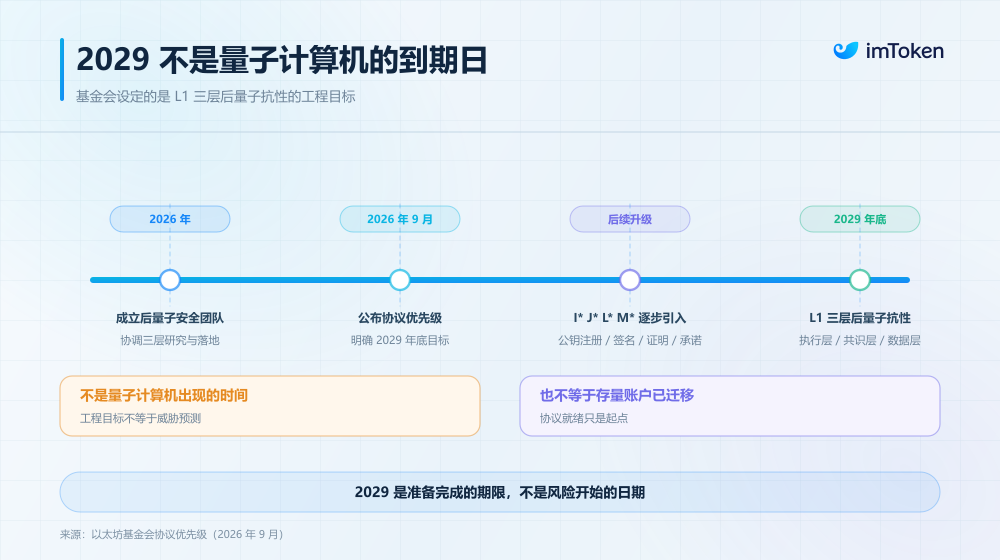
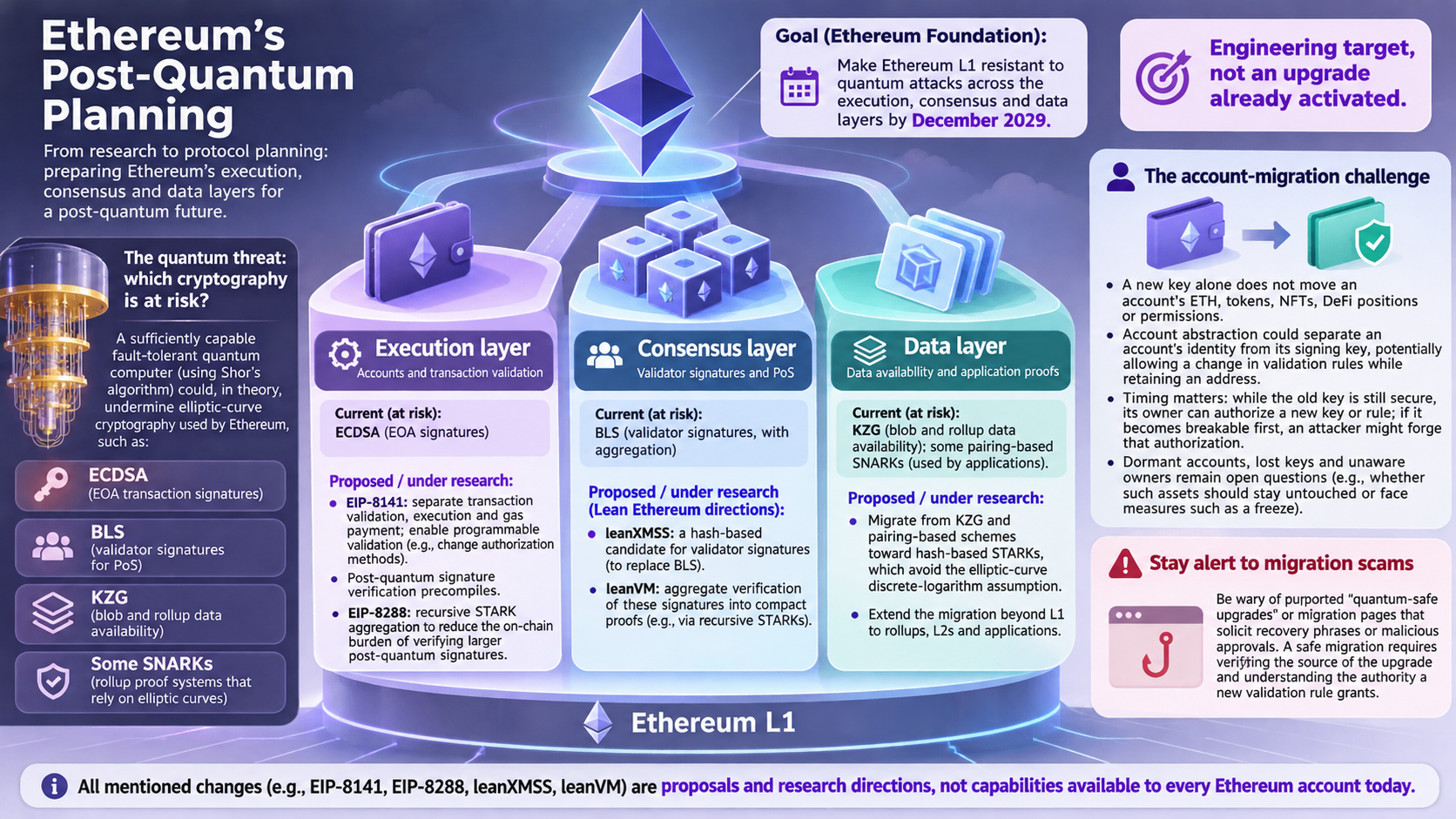
As reported by imToken on November 19, 2026, Ethereum’s post-quantum work was moving from research toward protocol planning. The article cited an Ethereum Foundation goal, published in September 2026, of making Ethereum L1 resistant to quantum attacks across its execution, consensus and data layers by December 2029. That is an engineering target, not an upgrade already activated.
The challenge is broader than choosing a new signature algorithm. Ethereum would also need a way for people to retain control of existing accounts, and for validators to keep performing consensus duties, while the cryptography beneath those activities changes.
Which cryptography is at risk?
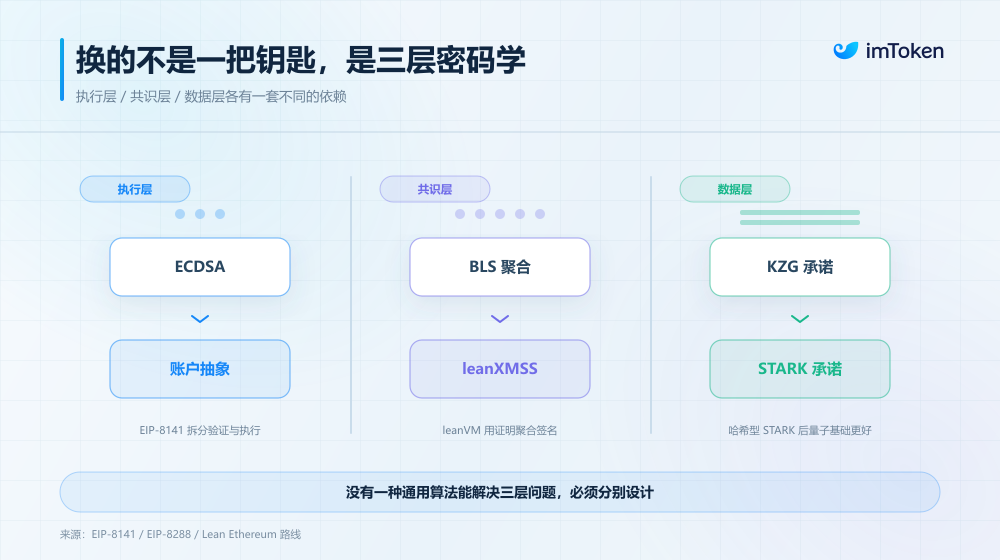
An ordinary Ethereum externally owned account (EOA) uses ECDSA signatures to authorize transactions. Validators use BLS signatures for proof-of-stake consensus; BLS allows many validator votes to be aggregated. Ethereum also uses KZG polynomial commitments for blob and rollup data availability, while some rollup proof systems rely on elliptic-curve assumptions.
According to imToken’s explanation, a sufficiently capable fault-tolerant quantum computer running Shor’s algorithm could, in theory, undermine the elliptic-curve mathematics behind ECDSA and BLS. An attacker able to derive a private key from a public key could forge signatures without obtaining a wallet’s recovery phrase. Validator keys and other signing authorities would face related risks. The article stressed that no quantum computer capable of breaking this cryptography had emerged as of its reporting date.
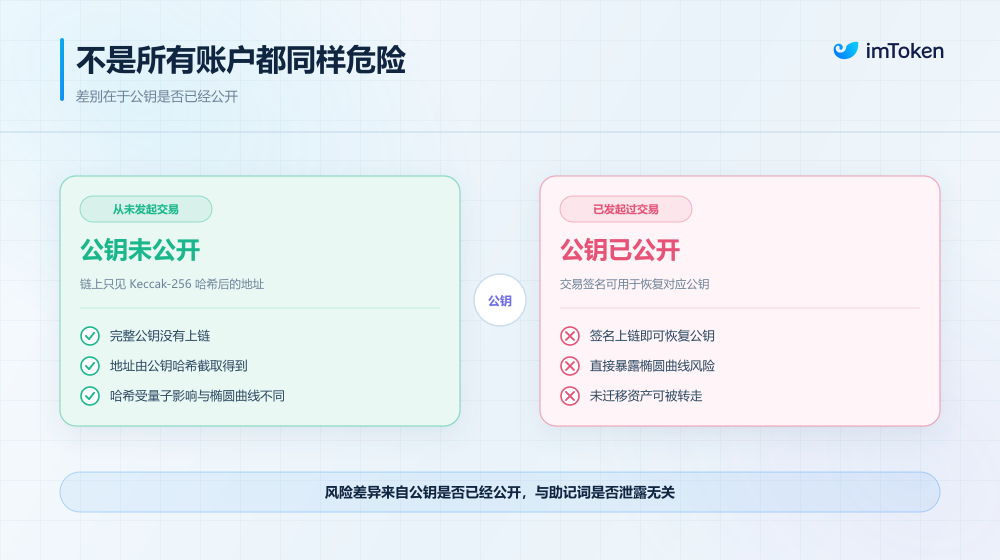
Exposure also differs between accounts. An EOA address is derived from a hash of its public key. If an account has never sent an on-chain transaction or otherwise disclosed a signature, its full public key may not be publicly exposed. Once it sends a transaction—including a token approval—its public signature can reveal that key. Hash functions such as Keccak-256 are considered more resilient to quantum attacks than the elliptic-curve systems discussed here, although they are not unaffected by quantum computing.
Separate changes for accounts, consensus and data
On the execution layer, the proposed EIP-8141 would separate aspects of transaction validation, execution and gas payment. Its proposed programmable validation could help accounts change authorization methods rather than remain permanently tied to one ECDSA key. Research into precompiles for verifying post-quantum signatures is another part of the work described by imToken. EIP-8288 proposes using recursive STARK aggregation to reduce the on-chain burden of verifying larger post-quantum signatures. These are proposals and research directions, not capabilities available to every Ethereum account today.
On the consensus layer, replacing BLS is particularly difficult because validators’ signatures must be communicated and checked across the network. The Lean Ethereum directions discussed in the article include leanXMSS, a hash-based candidate for validator signatures, and leanVM, intended to aggregate their verification into compact proofs. Neither should be read as a completed replacement for validators’ current signing process.
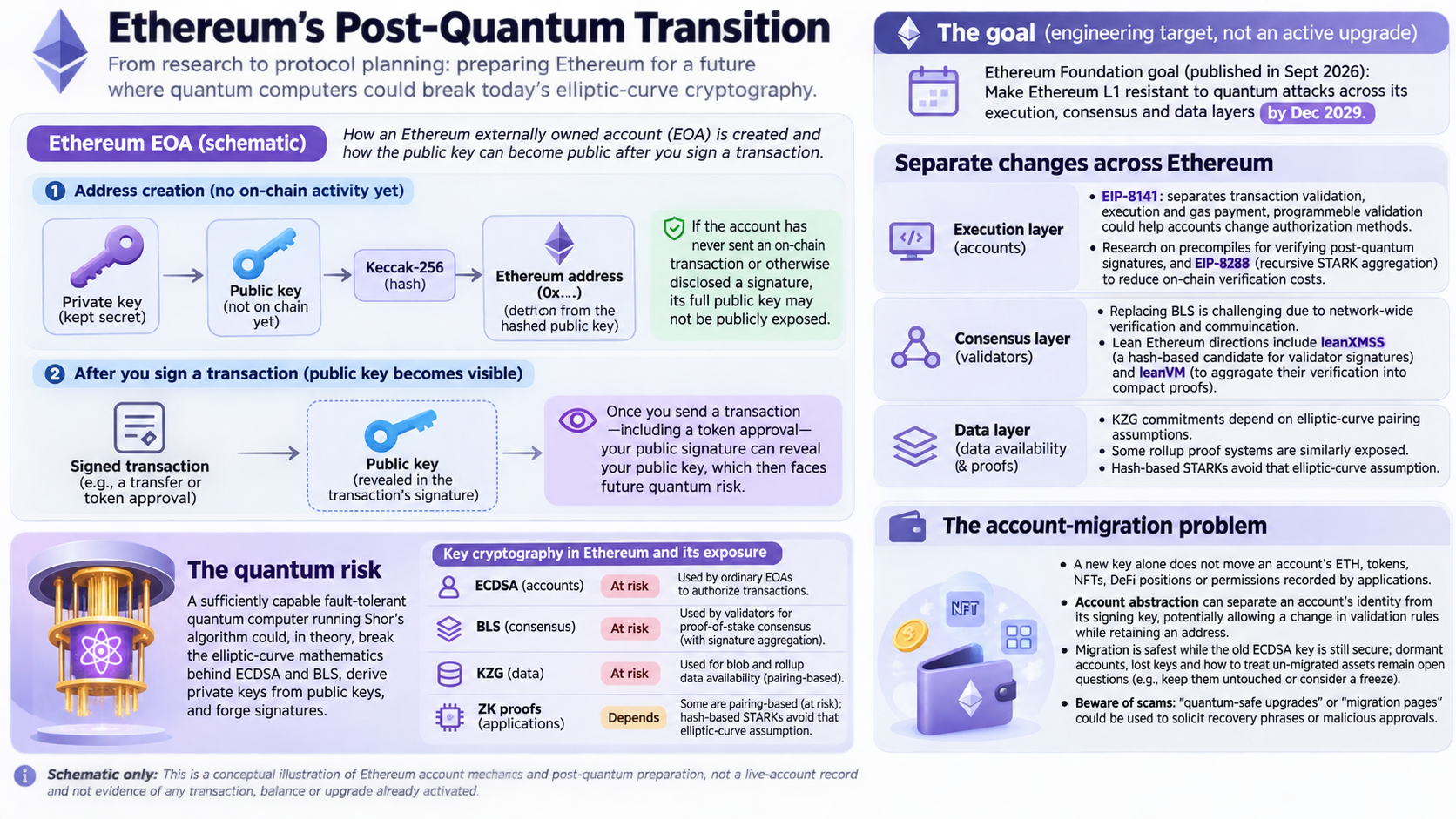
The data layer presents a separate problem: KZG commitments depend on elliptic-curve pairing assumptions. Some pairing-based SNARKs used by applications have similar long-term exposure. Hash-based STARKs avoid that particular elliptic-curve discrete-logarithm assumption. Any migration would therefore extend beyond L1 account and validator signatures to data infrastructure, rollups and applications.
The account-migration problem
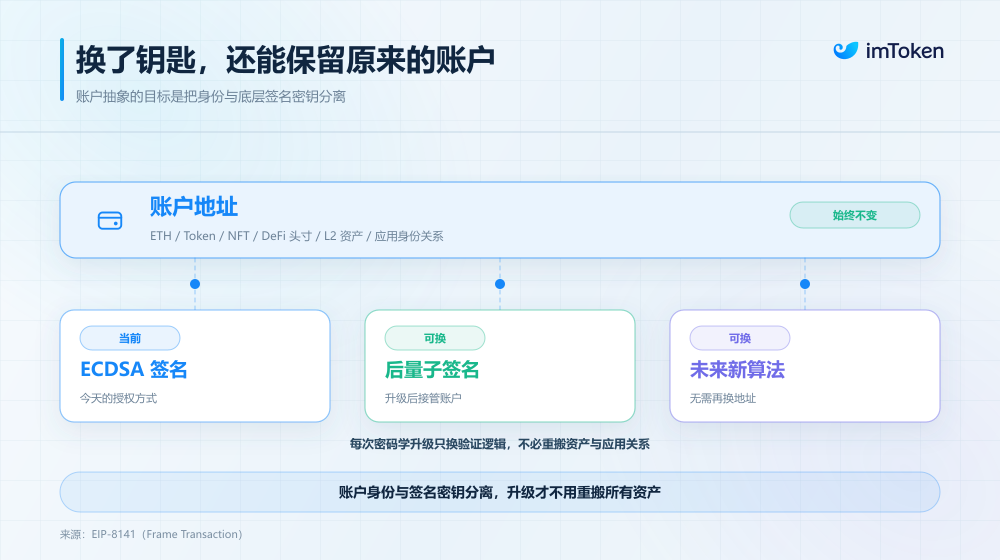
A new key alone does not move an account’s ETH, tokens, NFTs, DeFi positions or permissions recorded by applications. imToken described account abstraction as a possible way to separate an account’s identity from its signing key, potentially allowing a change in validation rules while retaining an address. Whether and how a given existing account could do that remains a matter for future designs and upgrades.
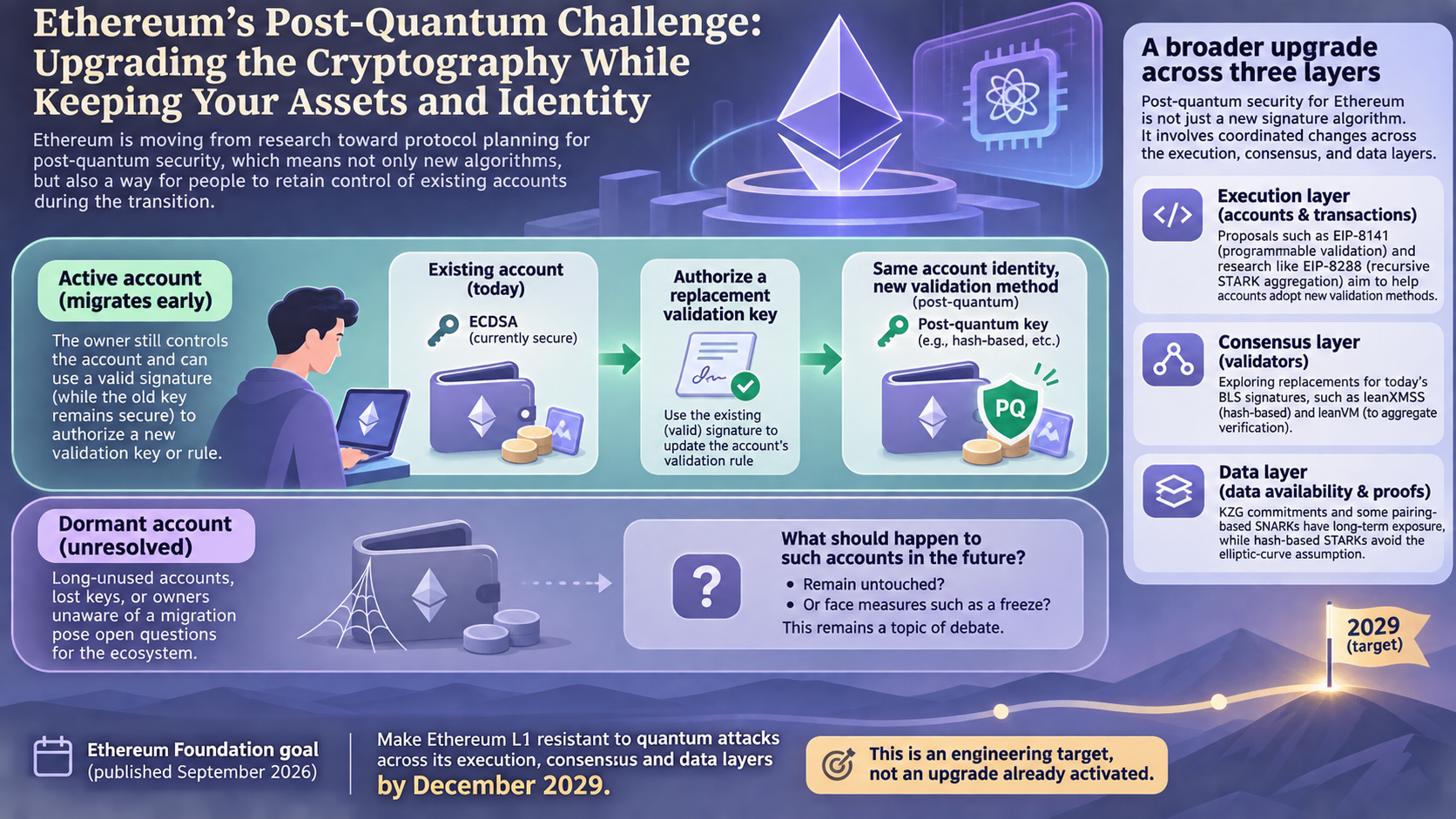
The timing matters. While an old ECDSA key is still secure, its owner could potentially use a valid signature to authorize a new key or validation rule. If that key became breakable first, an attacker might be able to produce the same old-key authorization, making ownership difficult to establish from the signature alone. Dormant accounts, lost keys and owners unaware of a migration pose further unresolved questions; the article notes debate over whether such assets should remain untouched or face measures such as a freeze.
As of the original November 2026 report, this was a preparation problem, not a reason to rush an asset transfer. The article also warned that purported “quantum-safe upgrades” or migration pages could be used to solicit recovery phrases or malicious approvals. A safe migration would require users to understand both the source of an upgrade and the authority a new validation rule grants.