
As reported on November 19, 2026, an attacker exploited share-accounting logic in K3 Capital’s sBOLD yield-bearing vault, which is built around Liquity’s BOLD stablecoin. Approximately $3.4 million in liquidity was withdrawn through 97 transactions over about eight minutes.
According to blockchain data firm Bitquery’s reconstruction, the attacker repeatedly deposited BOLD, introduced wrapped ether (WETH) that was not counted on the vault’s balance sheet, and converted it internally to BOLD. This inflated the redemption value of each sBOLD share, allowing withdrawals at the overstated value from funds deposited by other users.
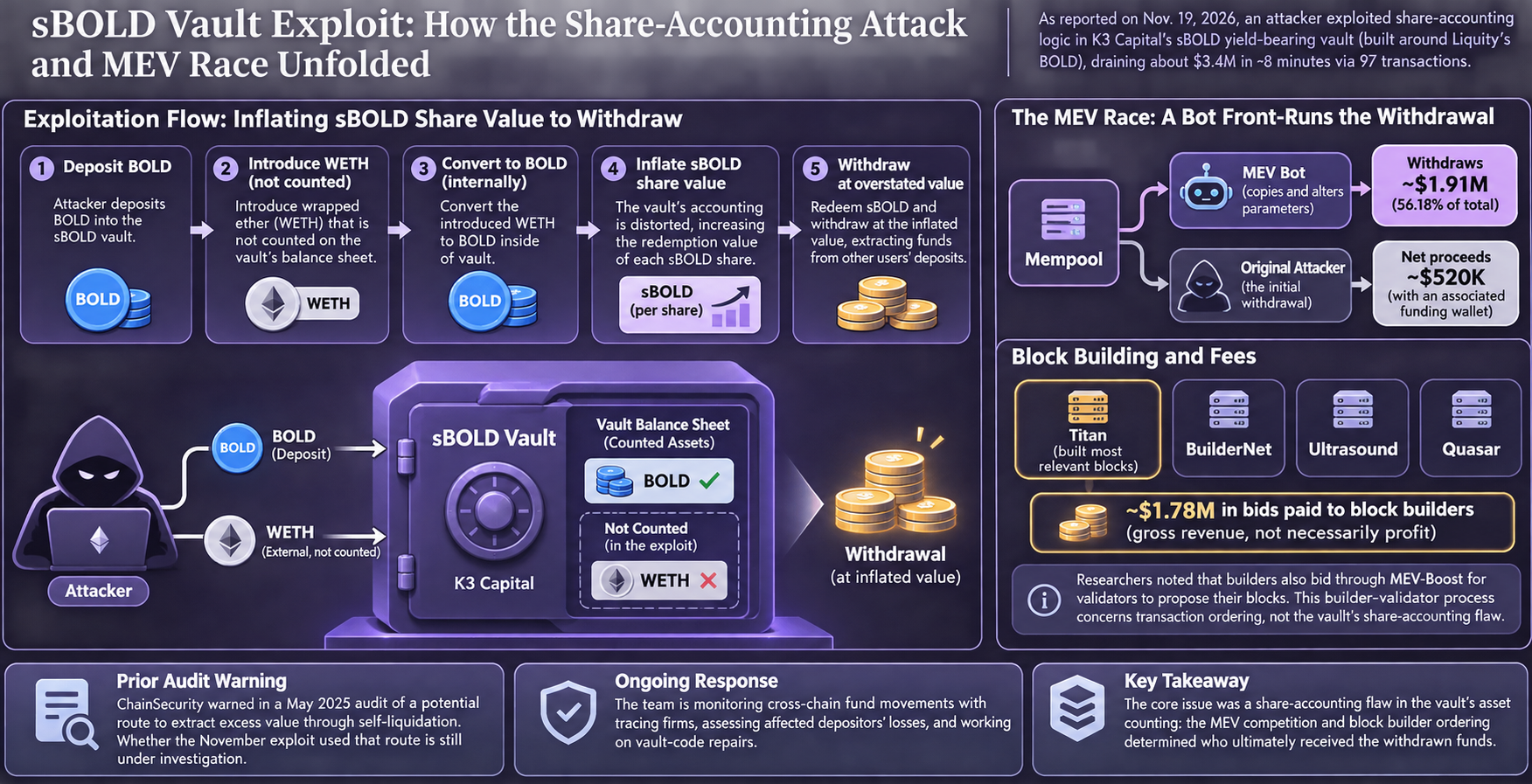
MEV bidding changed who received the funds. Bitquery said an automated bot saw the attacker’s withdrawal transaction in the mempool, copied it with altered parameters and moved ahead of it. The bot withdrew approximately $1.91 million, or 56.18% of the reported total, but paid about $1.78 million in bids for transaction inclusion, leaving roughly $130,000. The original attacker and an associated funding wallet ultimately received about $520,000 in net proceeds, according to the report.
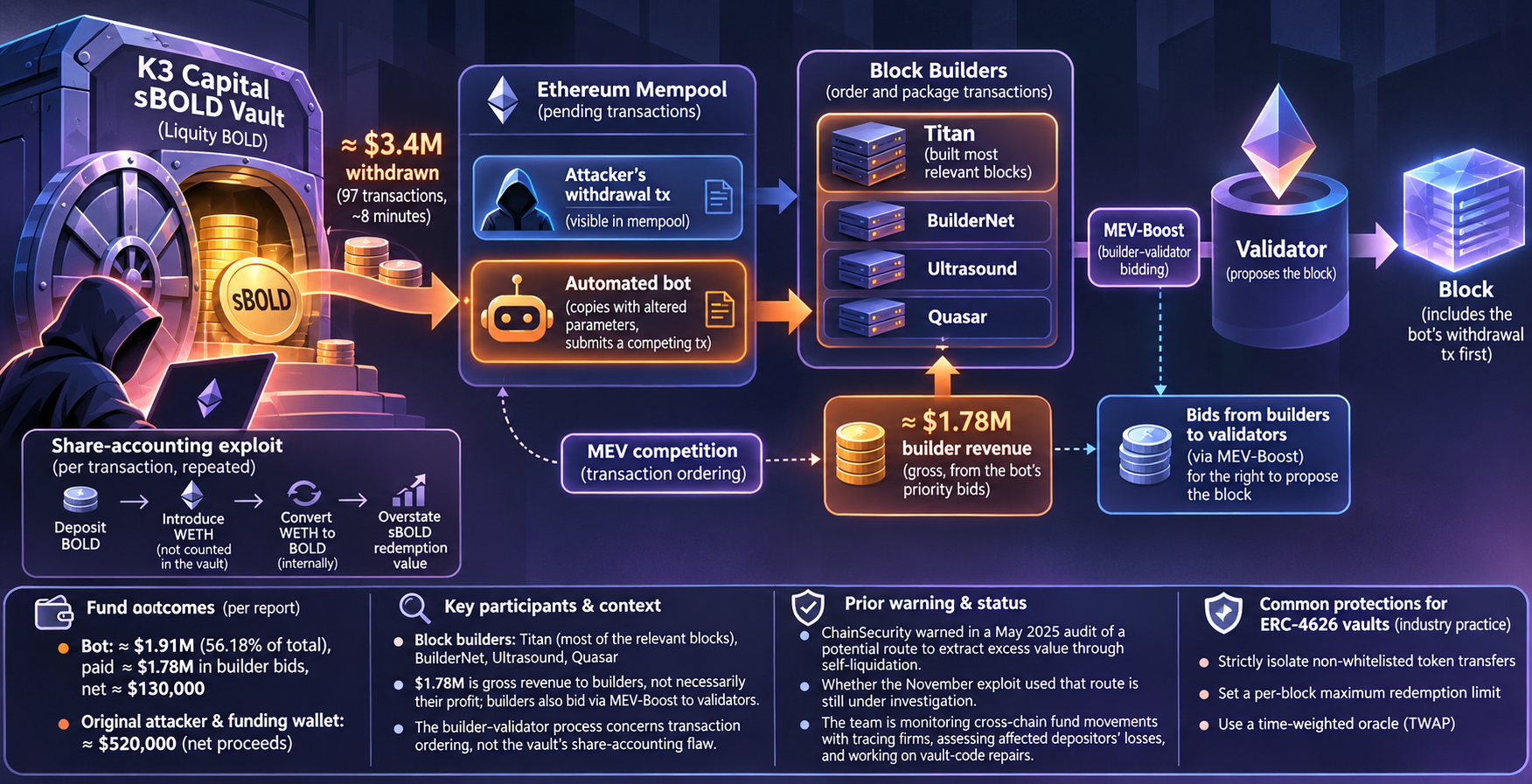
Titan built most of the blocks containing the bot’s transactions; BuilderNet, Ultrasound and Quasar also participated in ordering relevant blocks. Researchers cautioned that the $1.78 million was gross revenue to block builders, not necessarily their profit: builders also bid through MEV-Boost for validators to propose their blocks. That builder–validator process concerns transaction ordering, not the vault’s share-accounting flaw.
ChainSecurity had warned in a May 2025 audit of a potential route to extract excess value through self-liquidation. Whether the November exploit used that route was still under investigation. At the time of the report, the team was monitoring cross-chain fund movements with tracing firms, assessing affected depositors’ losses and working on vault-code repairs.