
As reported on November 23, 2026, this roundup covers project developments from November 16–22, alongside announced steps scheduled for later dates. These are separate project updates, not changes to Ethereum’s validator rules.
Stablecoins, staking and token supply
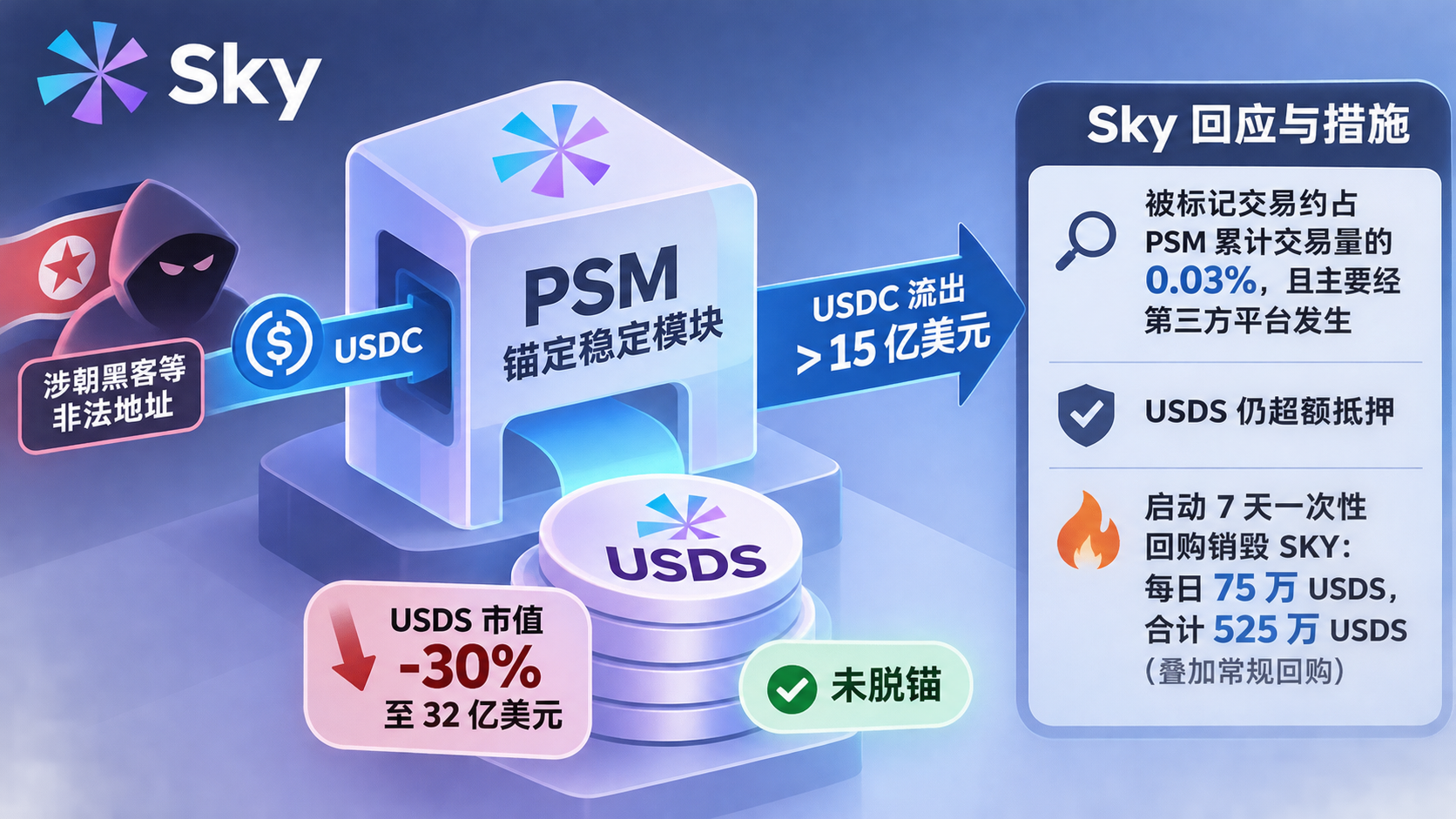
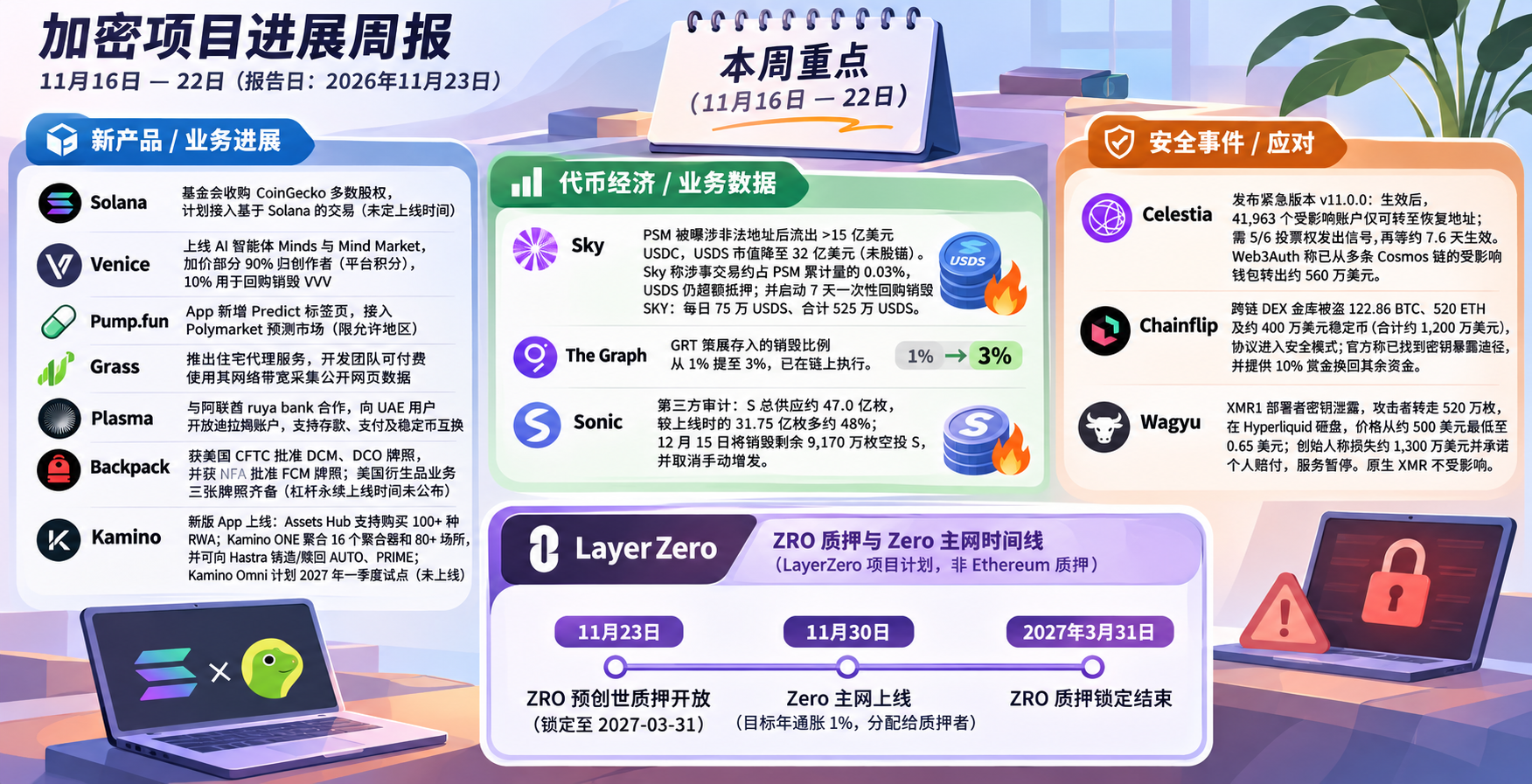
Sky: Reports alleged that illicit addresses, including ones linked to North Korean hackers, had used Sky’s Peg Stability Module (PSM), after which more than $1.5 billion in USDC flowed out. USDS’s market capitalization fell by more than 30% to $3.2 billion, but it did not lose its peg. Sky said flagged transactions represented about 0.03% of cumulative PSM volume, occurred mainly through third-party platforms, and that USDS remained overcollateralized. Separately, Sky’s Core Council announced a one-time, seven-day SKY buyback and burn of 750,000 USDS per day—5.25 million USDS in total—on top of regular buybacks.
LayerZero: The project announced pre-genesis ZRO staking opening November 23, with tokens locked until March 31, 2027. Its own chain, Zero, targeted 1% annual inflation distributed to stakers, with mainnet scheduled for November 30. Those are announced plans, not an Ethereum protocol change.
The Graph: A governance-approved increase in the GRT burn rate for curation deposits, from 1% to 3%, had been executed on-chain.
Sonic: A third-party-audited report put S supply at roughly 4.70 billion tokens, about 48% above the 3.175 billion stated at launch. Sonic said it would burn the remaining 91.7 million S allocated to an airdrop on December 15 and end manual issuance. Sonic is the rebranded Fantom chain, with FTM convertible to S at 1:1. The report attributed most of the extra supply to FTM on both Ethereum and Fantom Opera being eligible for that conversion.
Products and business developments
- Solana: The Solana Foundation acquired a majority stake in CoinGecko; the price and precise stake were undisclosed. It planned Solana-based trading within CoinGecko’s website, GeckoTerminal and app, without a launch date.
- Venice: Venice launched Minds and Mind Market, where paying users can create and publish AI agents. Creators can add a markup to inference prices and receive 90% of that markup as platform points; the other 10% goes entirely toward buying back and burning VVV.
- Pump.fun: Its app added a Predict tab integrating Polymarket prediction markets in permitted regions.
- Grass: It launched Grass Residential Proxies, a paid service through which development teams can use residential bandwidth in its network to collect public web data.
- Plasma: A partnership with UAE-based ruya bank offered UAE users dirham accounts for deposits, payments and stablecoin swaps.
- Backpack: It obtained CFTC approvals as a designated contract market and derivatives clearing organization, plus NFA approval to operate as a futures commission merchant. That completed the three licenses described as needed for its US derivatives business; no launch date was given for leveraged perpetual contracts for US users.
- Kamino: Its updated app introduced an Assets Hub for direct purchases of more than 100 real-world assets. Its Kamino ONE execution system aggregates 16 aggregators and more than 80 trading venues, and supports direct minting and redemption of Figure subsidiary Hastra’s AUTO and PRIME. Kamino Omni, an institutional platform for automated leveraged portfolios with tokens priced at real-time net asset value and usable as loan collateral, was planned for a first-quarter 2027 pilot; it had not launched.
Security incidents and responses
Celestia released emergency version v11.0.0 following private-key exposure involving Keplr wallets created through Google or Apple social login using older Web3Auth infrastructure. Once the measure takes effect, 41,963 affected accounts will be able to transfer funds only to recovery addresses. Activation requires a signal representing five-sixths of voting power, followed by a wait of about 7.6 days. Web3Auth said it had moved approximately $5.6 million from affected wallets across multiple Cosmos chains.
Chainflip reported that its cross-chain DEX vault lost 122.86 BTC, 520 ETH and roughly $4 million in stablecoins—about $12 million combined—and entered security mode. The project said it had identified how the key was exposed and offered a 10% bounty for the return of the remaining funds.
Wagyu reported exposure of the deployer key for XMR1, a wrapped XMR token on Hyperliquid. An attacker moved 5.2 million tokens and sold them on Hyperliquid, where the price fell from about $500 to as low as $0.65. Wagyu’s founder estimated losses at about $13 million, pledged personal compensation and paused the service. Native XMR was unaffected. Bitquery estimated that the attacker sold about $13.51 million worth to roughly 420 buyers. The founder blamed a breach at custody provider 1984.hosting, but that explanation had not been independently verified.