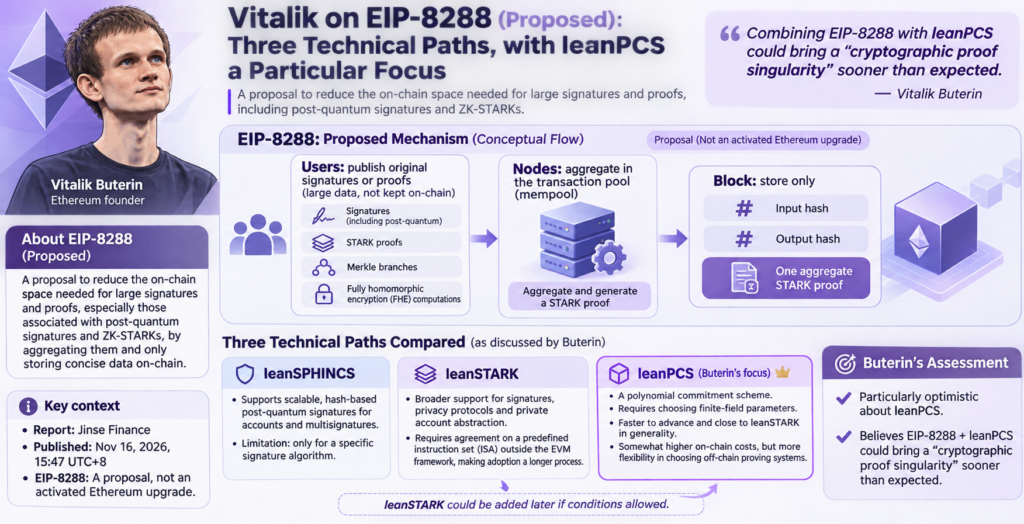
In a report published on November 16, 2026, at 15:47 UTC+8, Jinse Finance summarized a post in which Vitalik Buterin discussed the proposed EIP-8288 and three possible technical paths: leanSPHINCS, leanSTARK and leanPCS. Buterin said he had become particularly optimistic about leanPCS. EIP-8288 was a proposal, not an activated Ethereum upgrade.
As described in the report, the proposal aims to reduce the on-chain space needed for large signatures and proofs, including those associated with post-quantum signatures and ZK-STARKs. For computations that need to be performed once rather than repeatedly placed on-chain, users would publish the original signatures or proofs; nodes would aggregate them in the transaction pool; and a block would retain input and output hashes plus an aggregate STARK proof, rather than the original large proofs. The examples given include signatures, STARK proofs, Merkle branches and fully homomorphic encryption computations.
Buterin compared three approaches:
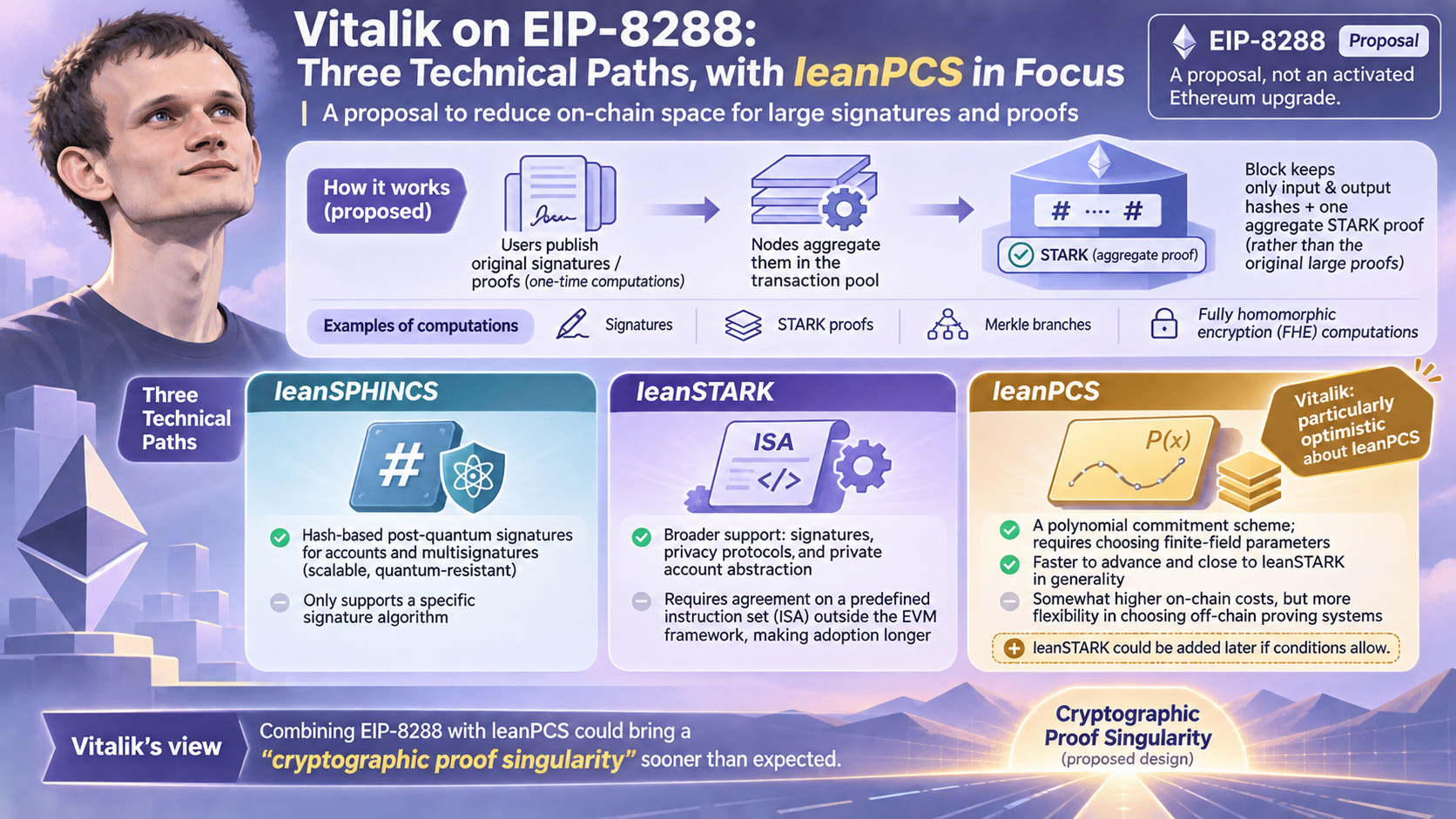
- leanSPHINCS would support scalable, hash-based post-quantum signatures for accounts and multisignatures, but only for a specific signature algorithm.
- leanSTARK would offer broader support for signatures, privacy protocols and private account abstraction. It would require agreement on a predefined instruction set outside the EVM framework, making adoption a longer process.
- leanPCS, a polynomial commitment scheme, would require choosing finite-field parameters. Buterin described it as faster to advance and close to leanSTARK in generality, with somewhat higher on-chain costs but more flexibility in choosing off-chain proving systems. He said leanSTARK could be added later if conditions allowed.
Buterin argued that combining EIP-8288 with leanPCS could bring what he called a “cryptographic proof singularity” sooner than expected. That was his assessment of a proposed design, not a claim that the mechanism was operating on Ethereum.