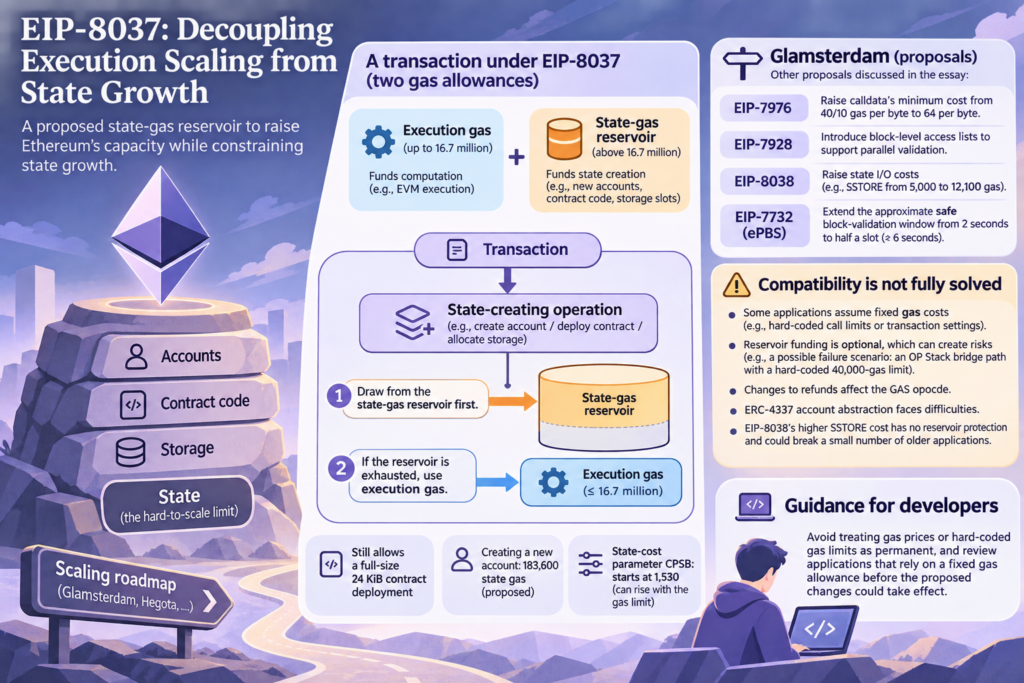
In an article published on November 16, 2026, at 18:01 UTC+8, TechFlow translated an essay attributed to Vitalik Buterin arguing that Ethereum cannot safely raise its gas limit without separately constraining the growth of its state—the accounts, contract code and storage that nodes must retain. The essay presents EIP-8037 as a proposal, not a rule already active on Ethereum.
Why state is the difficult limit
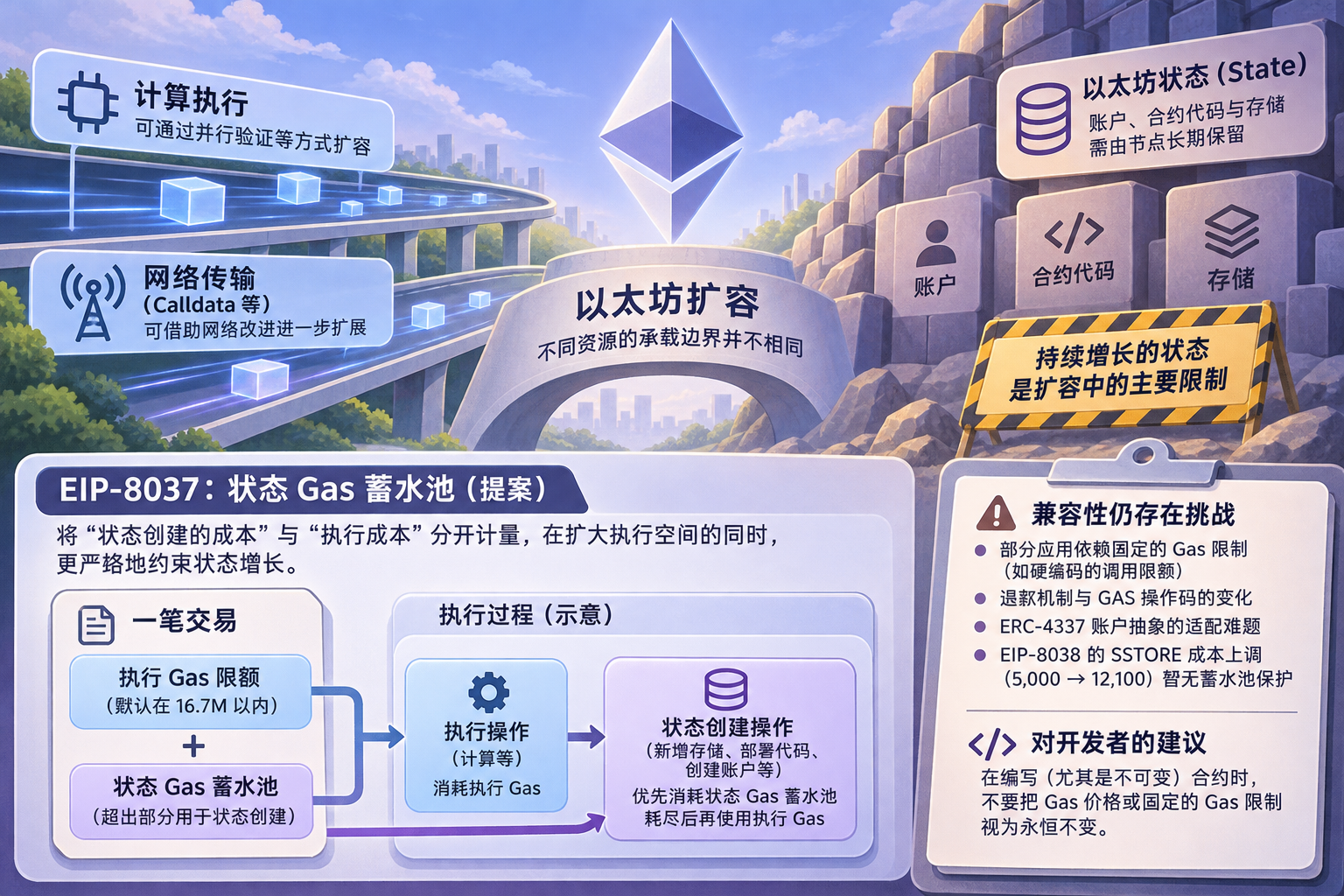
Buterin’s argument is that computation and data transmission can be scaled through measures such as parallel validation and network improvements, while permanently growing state places a continuing burden on node storage, initial synchronization and routine reads and writes. Simply raising the gas limit tenfold, he argues, would raise several resource demands together rather than addressing their different limits.
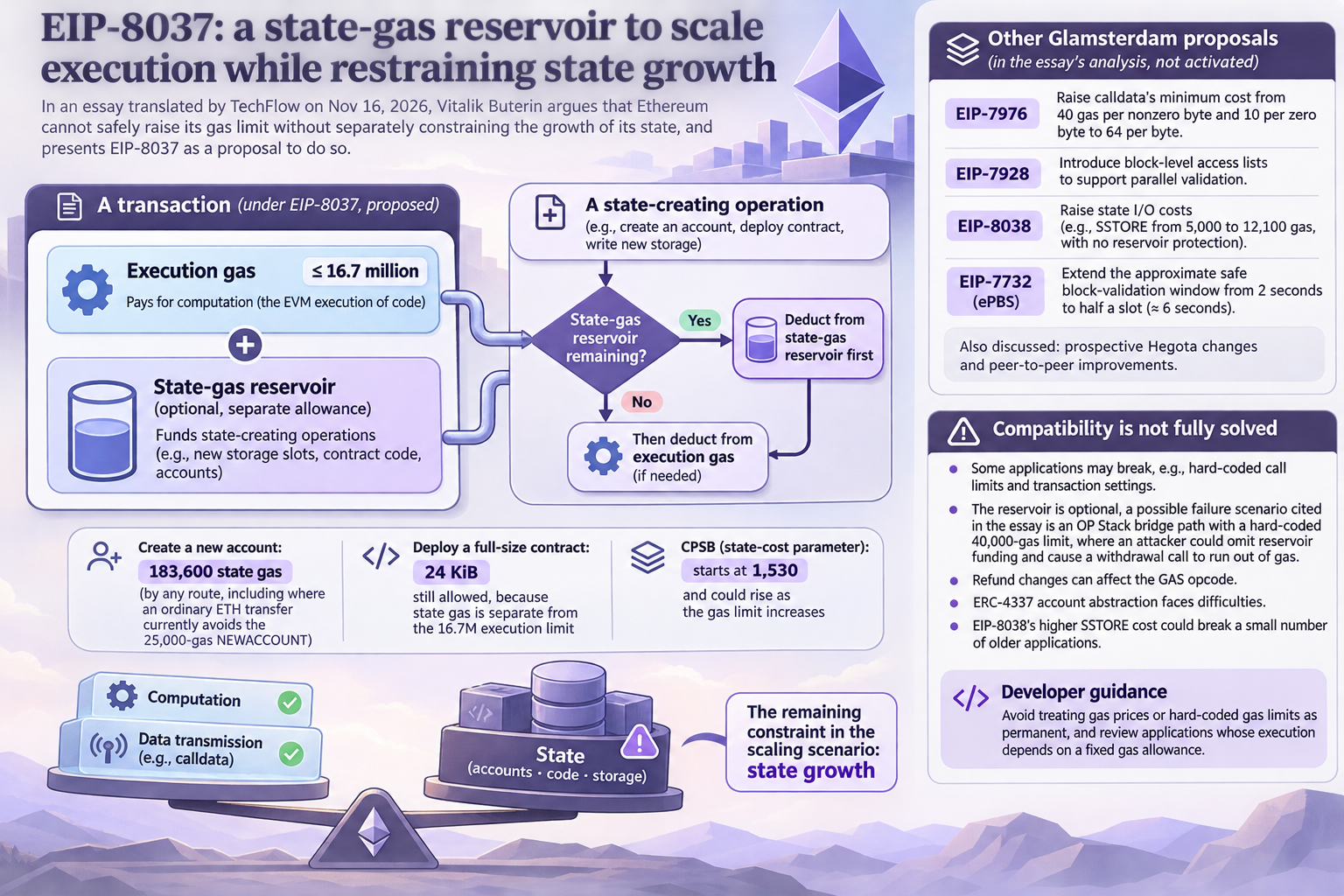
He discusses other proposals in the Glamsterdam roadmap alongside EIP-8037. In his account, EIP-7976 would raise calldata’s minimum cost from 40 gas per nonzero byte and 10 per zero byte to 64 per byte; EIP-7928 would introduce block-level access lists to support parallel validation; EIP-8038 would raise state I/O costs; and EIP-7732, or ePBS, would extend the approximate safe block-validation window from two seconds to half a slot, or about six seconds. These are proposed changes in the essay’s analysis, not a description of activated upgrades. Buterin also points to prospective Hegota changes and peer-to-peer improvements, while identifying state growth as the remaining constraint in his scaling scenario.
What the proposed reservoir would do
EIP-8037 would substantially increase charges for creating new state, including storage slots, code and accounts. Buterin says its proposed state-gas reservoir would let a transaction fund those charges separately from its execution-gas allowance. State-creating operations would draw from the reservoir first and then, if it were exhausted, from ordinary execution gas. A child call could use the transaction’s reservoir even when its parent limited the child’s execution gas.
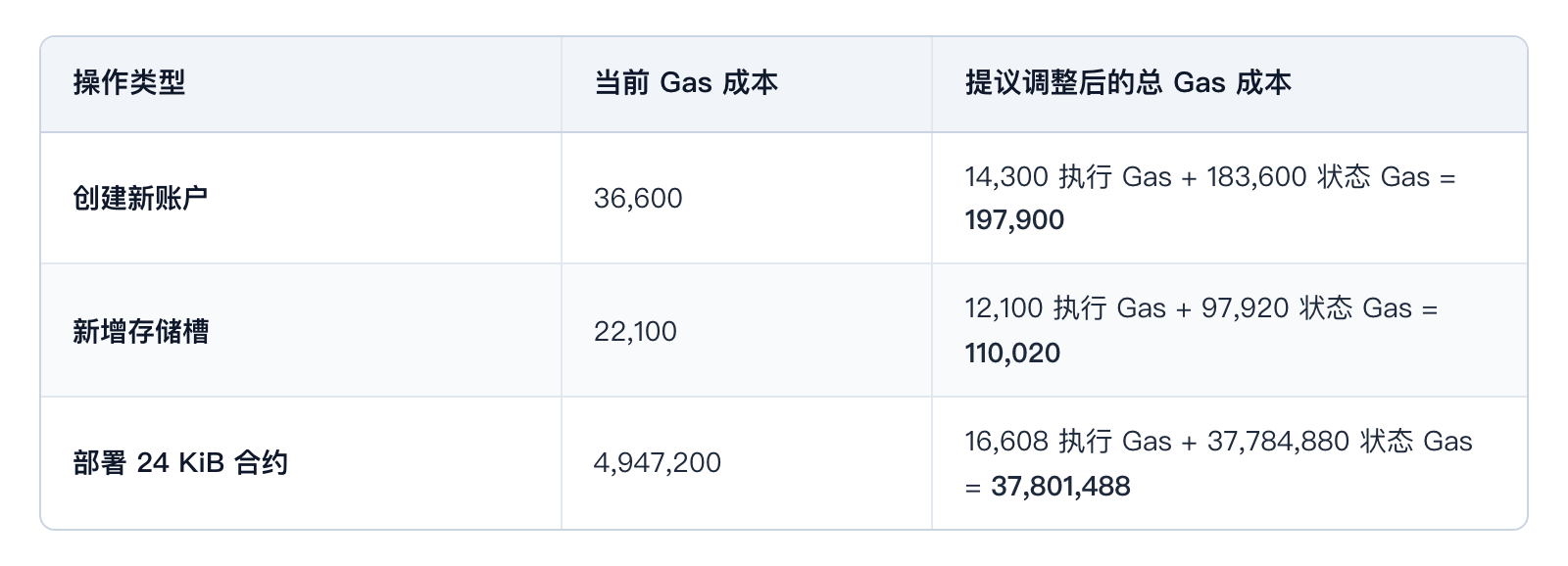
Under the proposal described in the essay, execution gas within a transaction’s 16.7 million limit would remain execution gas by default; gas supplied above that amount would fund the reservoir. That separation, Buterin says, would still permit deployment of a full-size 24 KiB contract despite the execution limit. He gives another proposed figure: creating a new account by any route would incur 183,600 state gas, including where an ordinary ETH transfer currently avoids the 25,000-gas NEWACCOUNT charge. The state-cost parameter CPSB would start at 1,530 and could rise as the gas limit increased. Buterin says a later EIP-8141 transaction design could make the two allowances more explicit.
Compatibility is not fully solved
The reservoir would not repair every application that assumes a fixed gas cost. Buterin identifies hard-coded call limits and transaction-building settings, the optional nature of reservoir funding, changes to how refunds affect the GAS opcode, and difficulties for ERC-4337 account abstraction. As a possible failure scenario, he cites an OP Stack bridge path with a hard-coded 40,000-gas limit: an attacker could omit reservoir funding, cause a withdrawal call to run out of gas and potentially have surrounding logic mark it processed. The essay does not establish that such an attack occurred.
Separately, Buterin says EIP-8038’s proposed increase in an SSTORE cost from 5,000 to 12,100 gas has no reservoir protection and could break a small number of older applications. He describes protocol-level remedies that had been discussed, but argues they could introduce further risks. The essay says Glamsterdam’s launch window had already been delayed as of its November 2026 reporting, with outreach to affected application developers underway; it does not establish the upgrade’s eventual status.
Buterin’s guidance for immutable-contract developers is to avoid treating gas prices or hard-coded gas limits as permanent. His wider list of possible future changes—including consensus rules affecting validator participation, rewards and penalties—is a forecast, not a statement that those changes have been adopted. The immediate issue raised by EIP-8037 is narrower: applications whose execution depends on a fixed gas allowance may need review before the proposed pricing changes could take effect.