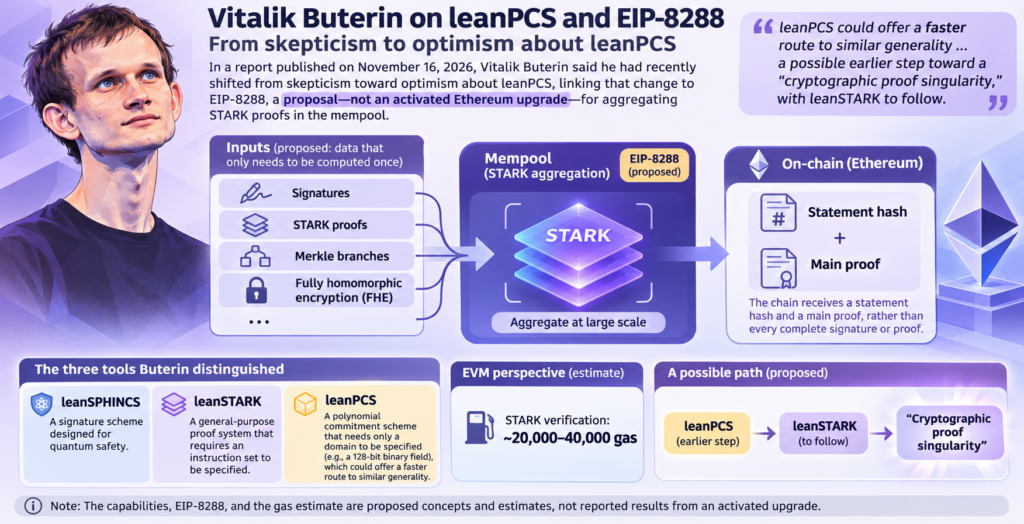
In a report published on November 16, 2026, Vitalik Buterin said he had recently shifted from skepticism toward optimism about leanPCS. He linked that change of view to EIP-8288, a proposal—not an activated Ethereum upgrade—for aggregating STARK proofs in the mempool.
Under the approach Buterin described, work that needs to be computed only once—including work involving signatures, STARKs, Merkle branches and fully homomorphic encryption (FHE)—could be aggregated at large scale. The chain would receive a statement hash and a main proof rather than every complete signature or proof.
Buterin distinguished three tools: leanSPHINCS, a signature scheme designed for quantum safety; leanSTARK, a general-purpose proof system that requires an instruction set to be specified; and leanPCS, a polynomial commitment scheme. He said leanPCS needs only a domain to be specified, such as a 128-bit binary field, and could therefore offer a faster route to similar generality. From the EVM’s perspective, he estimated STARK verification at roughly 20,000–40,000 gas under this approach. He presented leanPCS as a possible earlier step toward what he called a “cryptographic proof singularity,” with leanSTARK to follow. These are proposed capabilities and estimates, not reported results from an activated upgrade.