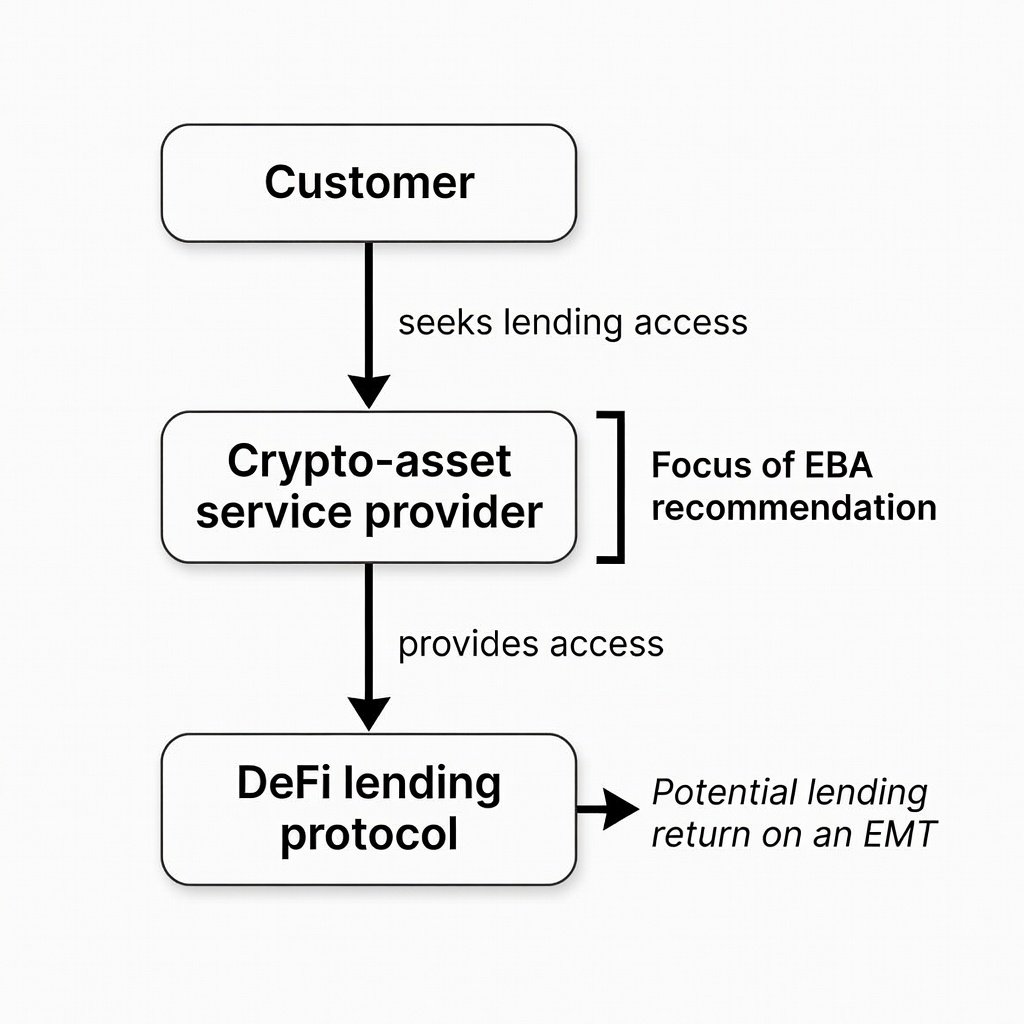
The European Banking Authority (EBA) has asked the European Commission to consider additional requirements for crypto-asset service providers that connect customers to decentralized finance (DeFi) lending protocols. The recommendation, set out in a November 25, 2026 report, targets the firms offering access rather than the protocols themselves. It does not establish new obligations.
Why stablecoin lending raises a regulatory question
The EU’s Markets in Crypto-Assets framework (MiCA) prohibits paying interest on electronic money tokens (EMTs), its category for stablecoins that track a single official currency. Crypto lending and borrowing, however, were left outside MiCA’s original scope.
The EBA identified a potential gap between those rules: a customer can use a lending protocol to earn a return on an EMT. A provider that directs the customer to that protocol may therefore make an interest-like return available without directly paying interest on the token. The EBA flagged this as a way firms might circumvent the restriction, not as a finding that a particular provider had violated it.
Consumer exposure and financial stability
Stablecoins, including EMTs, supply liquidity, serve as collateral and settle transactions in DeFi, according to the report. The EBA observed a modest rise in EU consumer participation, driven mainly by providers offering DeFi-linked products, alongside growing institutional interest. Among European investors surveyed, 42% expected to participate in DeFi by 2028. That figure measures expectations, not current use. Separately, the report put decentralized exchanges’ share of global spot trading volume at approximately 10%, above the EU average.
For customers, the EBA highlighted inadequate disclosure of fees and collateral terms, high leverage in some products and the possibility of losing all deposited assets. It also identified operational vulnerabilities and risks related to money laundering and terrorist financing. Those findings were distinct from its assessment of the broader financial system: the EBA identified no immediate financial stability risks in the EU from crypto lending, borrowing or staking.
The report draws on work the EBA and the European Securities and Markets Authority conducted between January and September 2026 to inform the ongoing MiCA review. Separately, in October 2026, USDC became the first EMT designated as “significant” under MiCA, placing it under direct EBA supervision.