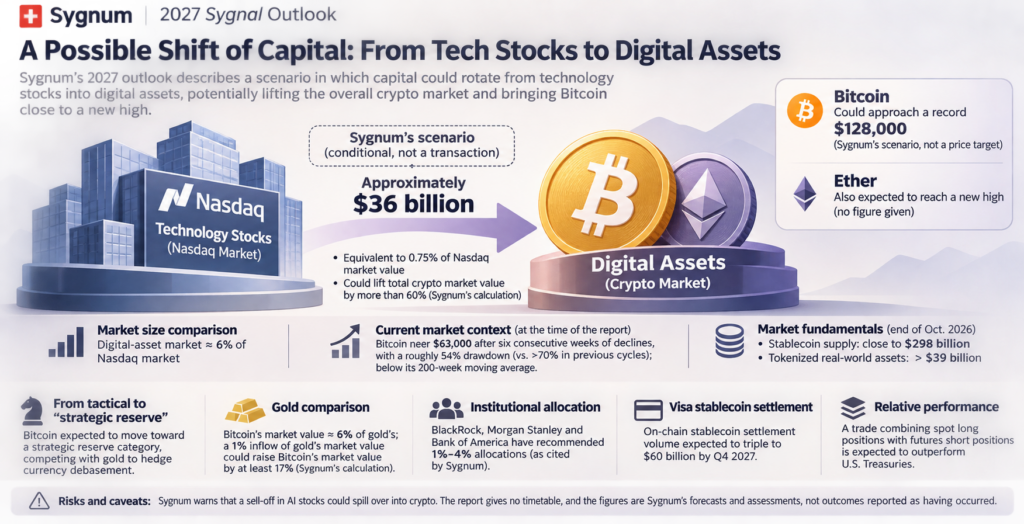
In reporting published on November 20, 2026, Swiss digital-asset bank Sygnum’s 2027 Sygnal outlook projected that Bitcoin could approach a record $128,000 and Ether could also reach a new high. The report, released November 19, expected gains to remain concentrated rather than spread evenly across the market. It gave no figure for Ether’s projected high.
The capital-flow scenario
Sygnum based its Bitcoin scenario on a possible shift of capital from technology stocks into digital assets. By its calculations, the digital-asset market was about 6% the size of the Nasdaq market. It estimated that an inflow of roughly $36 billion—equivalent to 0.75% of Nasdaq market value—could lift total crypto market value by more than 60% and bring Bitcoin close to $128,000. Sygnum provided no timetable and described the figure as its own calculation, not a price target. It also warned that a sell-off in AI stocks could spill over into crypto.
At the time of the report, Bitcoin was trading near $63,000 after six consecutive weeks of declines and a move below its 200-week moving average. Sygnum characterized the downturn as Bitcoin’s shallowest bear market to date, with a roughly 54% drawdown versus declines exceeding 70% in previous cycles. The bank argued that digital assets were entering 2027 with lower structural volatility and stronger fundamentals. As of the end of October 2026, stablecoin supply was close to $298 billion and tokenized real-world assets exceeded $39 billion.
Sygnum also expected Bitcoin to move from a tactical portfolio holding toward a “strategic reserve” category, competing with gold for capital seeking protection against currency debasement. The report said BlackRock, Morgan Stanley and Bank of America had recommended allocations of 1%–4%. It estimated Bitcoin’s market value at about 6% of gold’s and calculated that an inflow equal to 1% of gold’s market value could raise Bitcoin’s market value by at least 17%.
Other forecasts included a tripling of Visa’s on-chain stablecoin settlement volume to $60 billion by the fourth quarter of 2027, and stronger performance for a trade combining spot long positions with futures short positions than for US Treasuries. Chief investment officer Fabian Dori said volatility had not disappeared but had shifted from the assets themselves to market infrastructure, while institutional adoption continued to build. These are Sygnum’s forecasts and assessments, not outcomes reported as having occurred.