
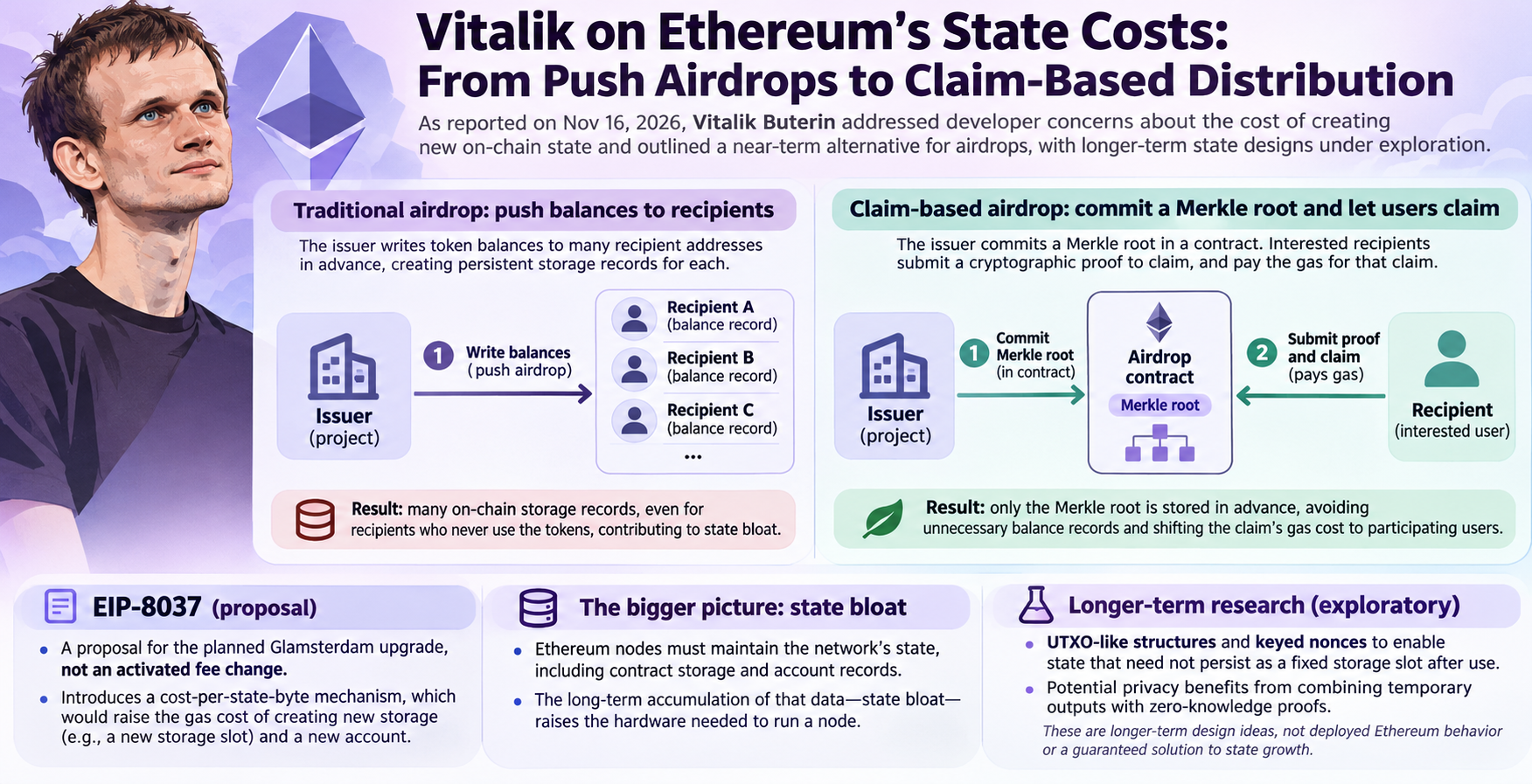
As reported on November 16, 2026, Ethereum co-founder Vitalik Buterin addressed developers’ concerns about the cost of creating new on-chain state. The concern followed a proposal to raise gas costs for new storage. EIP-8037 was a proposal for the planned Glamsterdam upgrade, not an activated fee change.
Why new storage matters
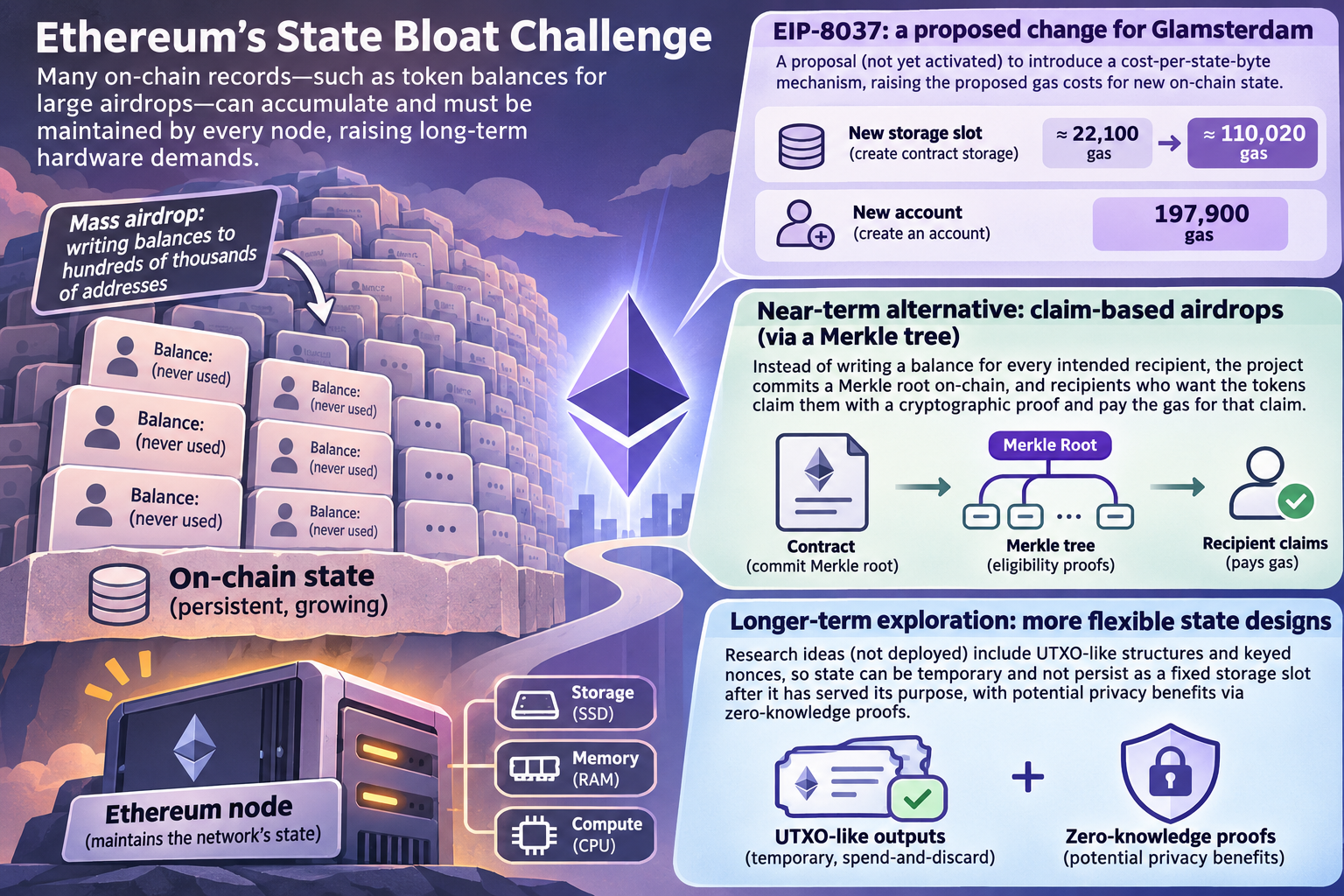
Ethereum nodes must maintain the network’s state, including contract storage and account records. The article described the long-term accumulation of that data—state bloat—as a constraint on the hardware needed to run a node. A project that writes token balances to hundreds of thousands of addresses can create records even for recipients who never use the tokens.
EIP-8037 proposes a cost-per-state-byte mechanism. Under the figures reported at the time, creating a new storage slot would rise from about 22,100 gas to 110,020 gas, while creating a new account would cost 197,900 gas. Those are proposed gas costs, not a report of fees already in effect.
Claim-based airdrops as a near-term alternative
Buterin pointed to Merkle-tree-based claims rather than pushing balances to every intended recipient. A project can commit a Merkle root in a contract; a recipient who wants to claim then submits a cryptographic proof and pays the gas for that claim. This avoids creating balance records in advance for addresses that never claim, while shifting the claim transaction’s gas cost to participating recipients.
Longer-term state designs remain exploratory
Buterin also discussed UTXO-like structures and keyed nonces in Ethereum research-forum and blog writing, according to the report. The aim is to explore state that need not persist as a fixed storage slot after it has served its purpose. The report also raised potential privacy benefits from combining temporary outputs with zero-knowledge proofs. These are longer-term design ideas, not deployed Ethereum behavior or a guaranteed solution to state growth.