
In a November 16, 2026, explanation, Ethereum co-founder Vitalik Buterin said he had become strongly supportive of leanPCS, an approach within the draft EIP-8288 proposal that he believes could speed up Ethereum’s move toward quantum-resistant cryptography. Neither EIP-8288 nor leanPCS had been described as an activated network upgrade.
The problem is size. Buterin said quantum-safe signatures could grow from 65 bytes to between 1 and 6 kilobytes, while some zero-knowledge proofs could expand from a few hundred bytes to about 128 kilobytes. Storing all of that data onchain would be unsustainable, he argued.
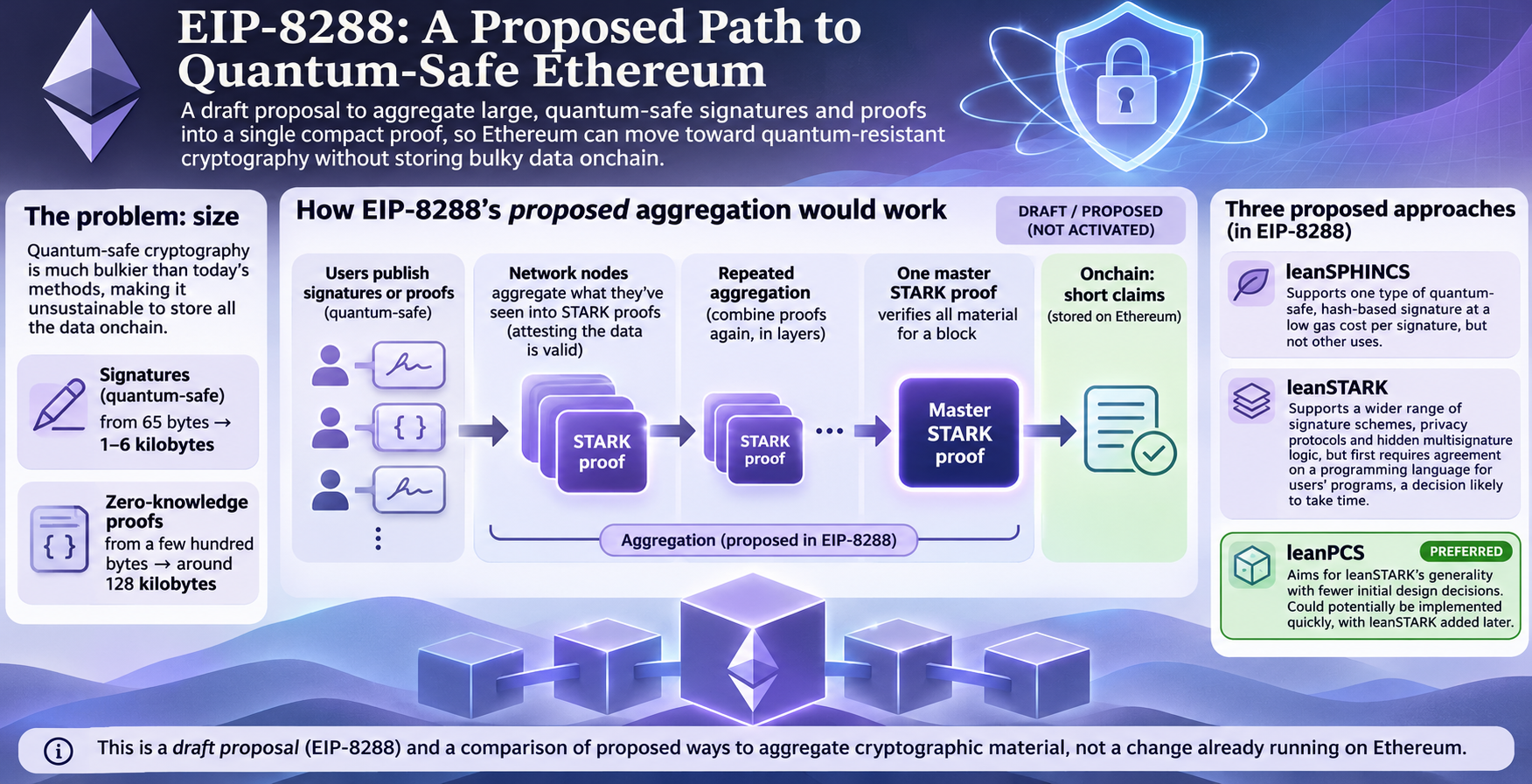
How the proposed aggregation would work
Buterin co-authored EIP-8288 with developer Thomas Coratger in June. Under its proposed design, users would publish signatures or proofs, and network nodes would repeatedly combine the material they have seen into STARK proofs attesting that the underlying data is valid. Those proofs would be combined again until one master proof verifies the material for a block. The chain would store short claims rather than the full signatures and proofs.
Buterin outlined three possible approaches:
- leanSPHINCS would support one type of quantum-safe, hash-based signature at a low gas cost per signature, but not other uses.
- leanSTARK would support a wider range of signature schemes, privacy protocols and hidden multisignature logic. Buterin said it would first require agreement on a programming language for users’ programs, a decision likely to take time.
- leanPCS, his preferred route, aims for leanSTARK’s generality with fewer initial design decisions. Buterin said it could potentially be implemented quickly, with leanSTARK added later.
The comparison is between proposed ways to aggregate cryptographic material, not between changes already running on Ethereum.
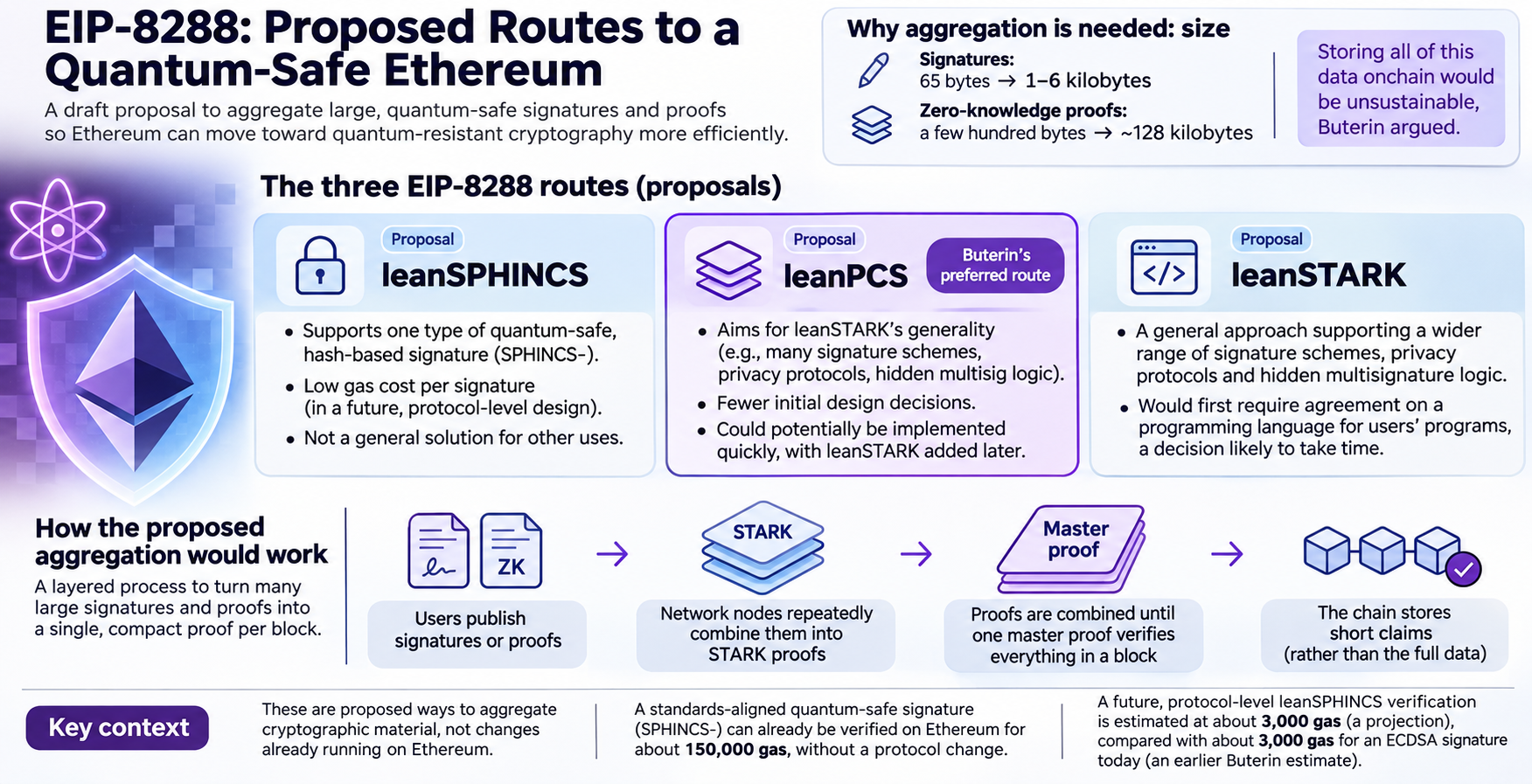
The current cost comparison
Buterin also pointed to SPHINCS-, a family of hash-based signatures described in a June Ethereum Research post. According to that post, a standards-aligned quantum-safe signature can already be verified on Ethereum without a protocol change for about 150,000 gas. An earlier Buterin estimate put verification of an ECDSA signature at about 3,000 gas. The post estimated that verification using a future, protocol-level leanSPHINCS aggregation design would cost about 3,000 gas; that figure is a projection, not a cost achieved by an activated upgrade.
The broader work remains in development. The Ethereum Foundation formed a dedicated post-quantum team in January, while developers have proposed changes to the staking deposit contract to support post-quantum validator keys. Those validator-key changes, like EIP-8288, were described as proposals rather than deployed protocol rules.