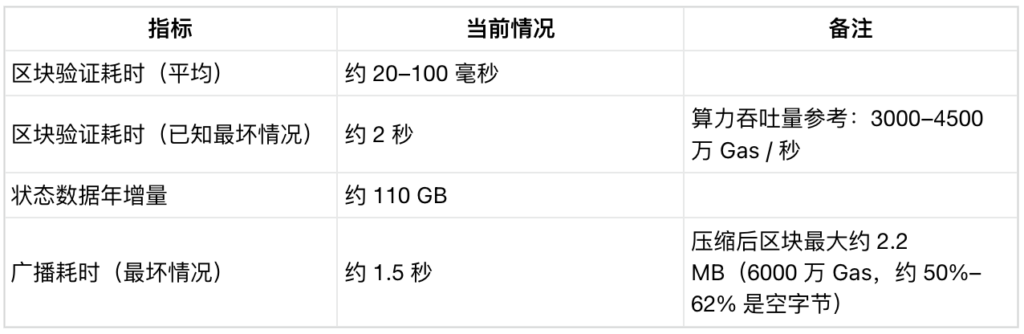
In an essay reported on November 16, 2026, Vitalik Buterin argued that Ethereum can increase its capacity for computation more readily than it can accommodate a rapidly growing state—the accounts, contracts and storage that nodes must retain. He presented EIP-8037 as a proposal to price new state more heavily, allowing execution capacity to grow without assuming that state can grow at the same rate. It was not described as an activated rule.
Why a higher gas limit is not enough
Buterin used a hypothetical tenfold increase in Ethereum’s gas limit to separate several pressures that would otherwise rise together: block validation work, calldata and block propagation, state reads and writes, and the amount of state nodes must hold. Larger state would increase storage needs, slow synchronization and make state access harder for the execution layer.
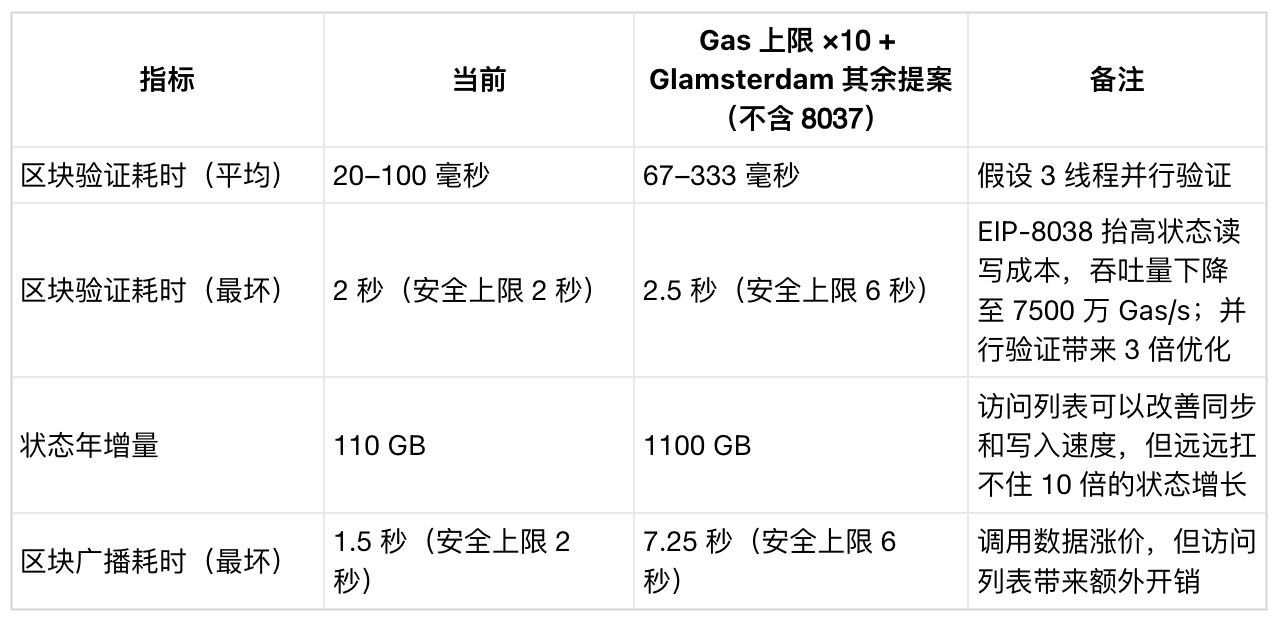
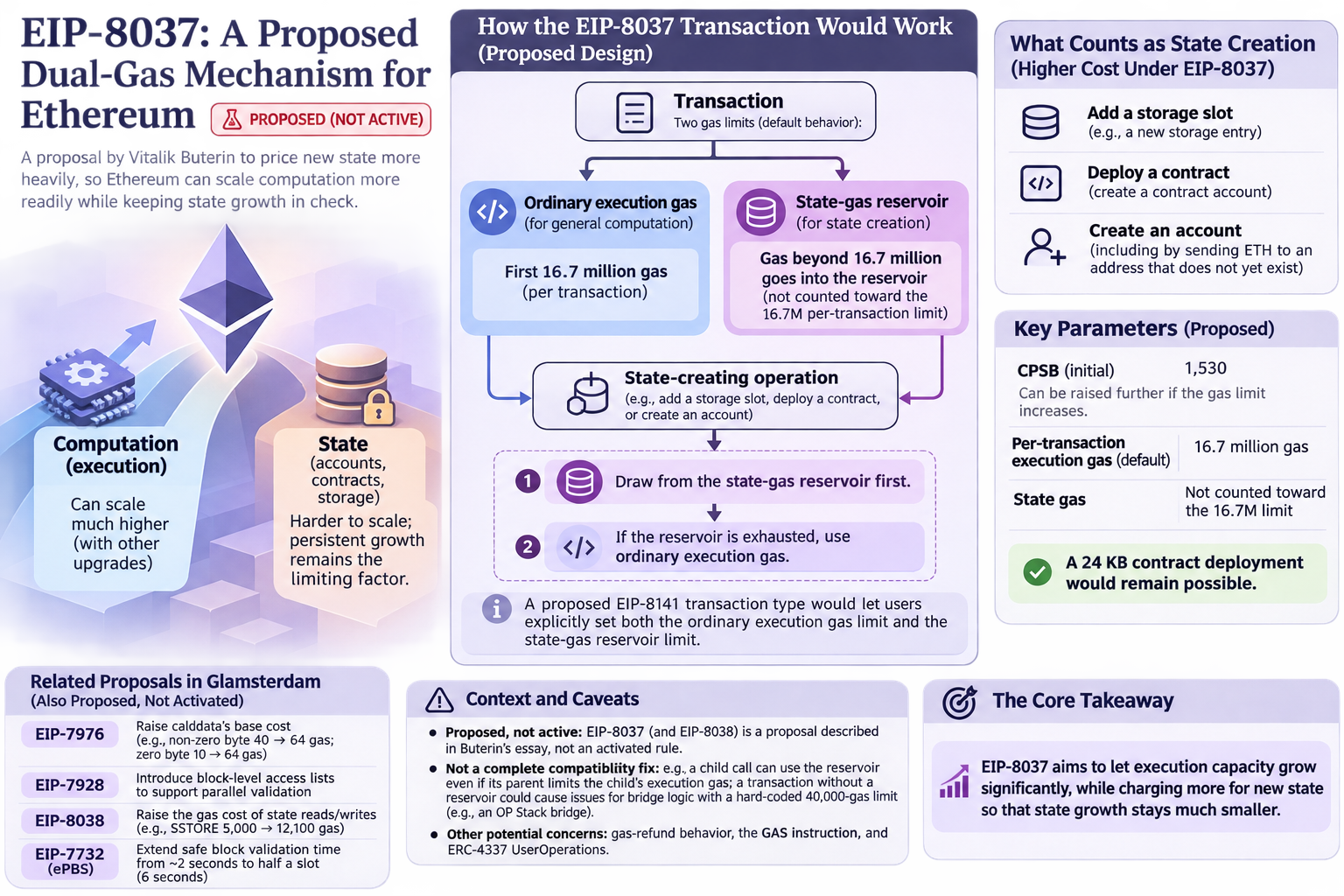
He described other proposals associated with Glamsterdam as addressing different constraints. EIP-7976 would raise calldata’s base cost; EIP-7928 would introduce block-level access lists to support parallel validation; EIP-8038 would raise the gas cost of state reads and writes; and EIP-7732, or ePBS, would extend the time available for safe block validation from about two seconds to half a slot, or six seconds. In Buterin’s assessment, those measures and further planned changes could make a much higher gas limit workable for computation and calldata. Persistent state growth would remain the limiting factor. These are his projections about proposals, not observed results from an upgraded network.
What EIP-8037 would change
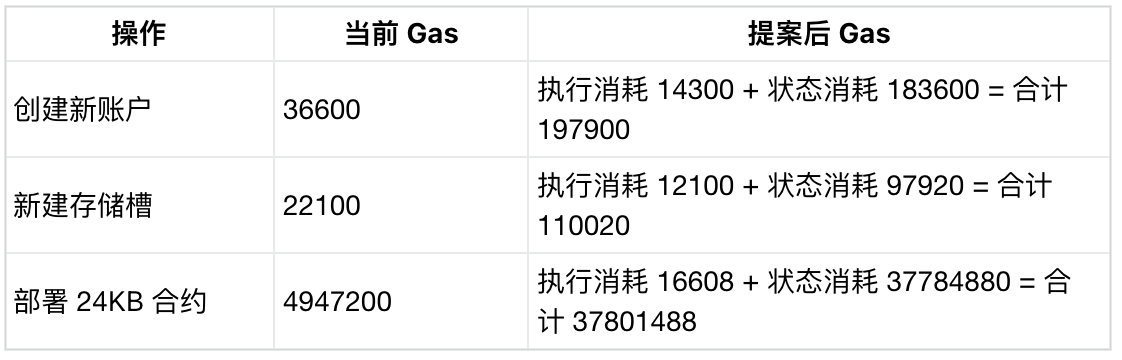
EIP-8037 would sharply increase the cost of creating state, including adding a storage slot, deploying a contract or creating an account. Buterin said the account-creation charge would apply regardless of how the account is created, including by sending ETH to an address that does not yet exist. The proposal’s initial CPSB parameter would be 1,530 and could be raised if the gas limit increased further.
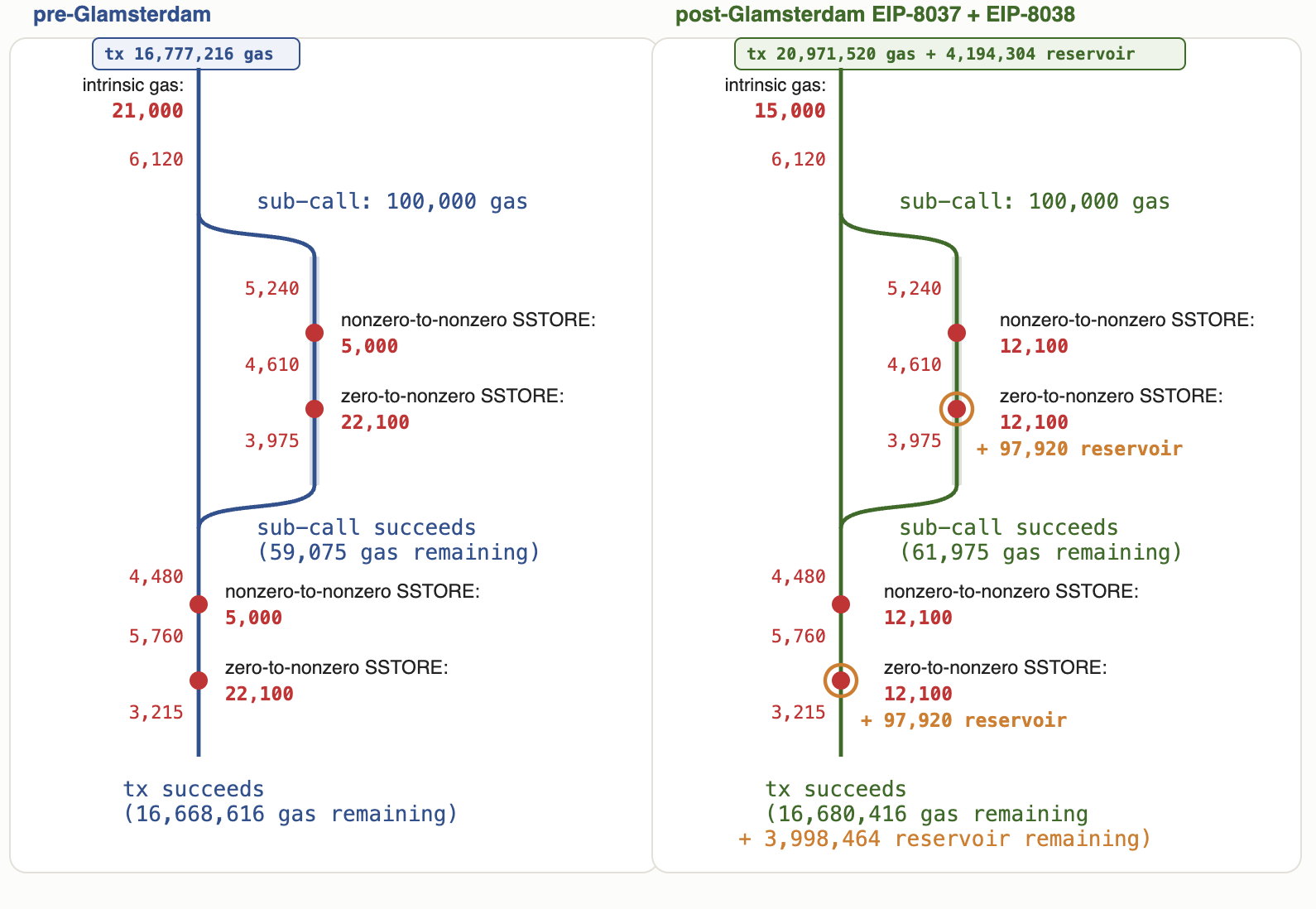
The proposal would also separate ordinary execution gas from a state-gas reservoir. In Buterin’s description, a transaction’s first 16.7 million gas would normally be ordinary execution gas, with gas beyond that going into the reservoir. State-creating operations would draw from the reservoir first and use ordinary execution gas only after it was exhausted. State gas would not count toward the 16.7 million-gas per-transaction limit, so he said a 24 KB contract deployment would remain possible. A proposed EIP-8141 transaction type would let users specify the two limits explicitly.
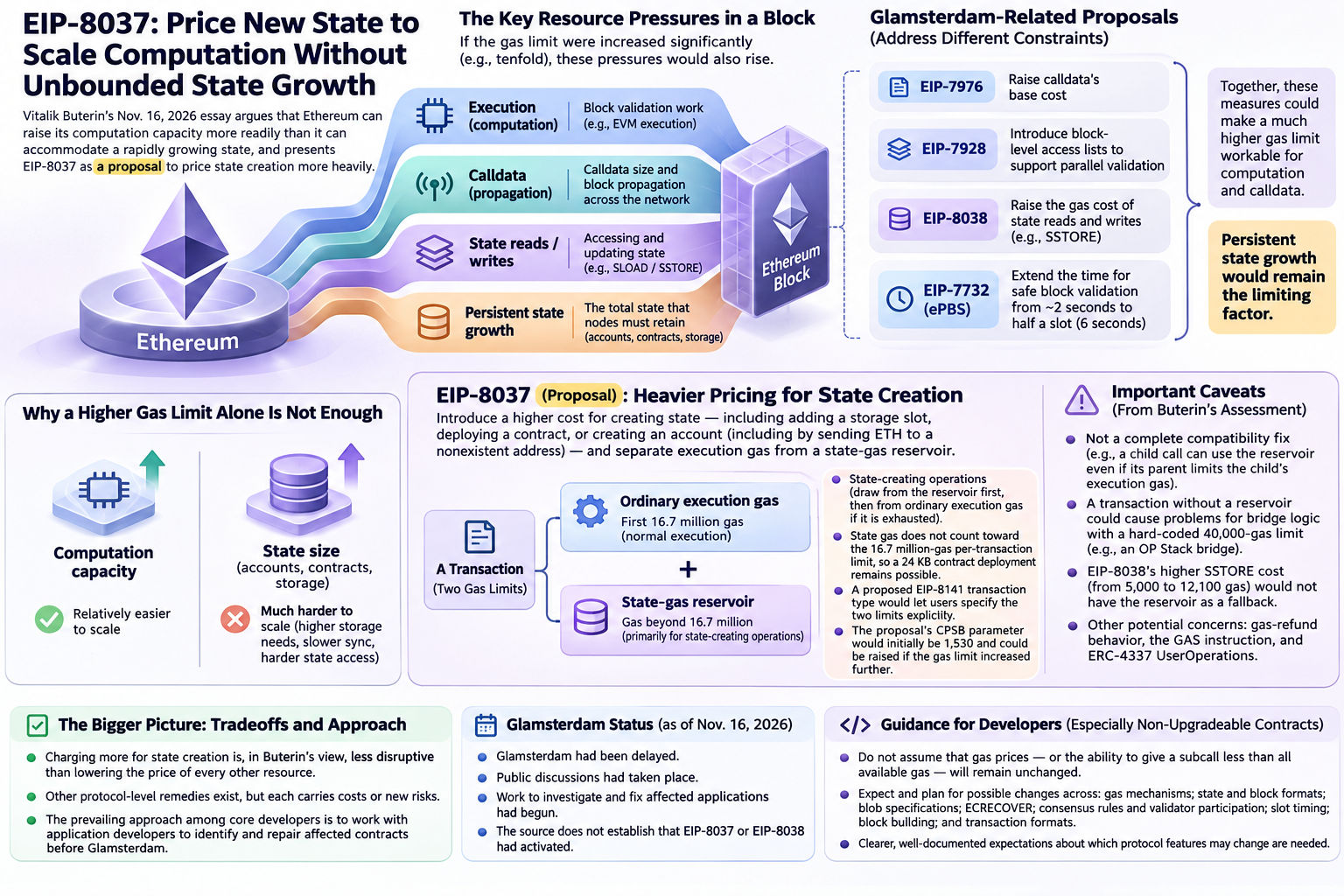
Buterin’s argument is that charging more for state creation is less disruptive than lowering the price of every other resource. He did not portray the reservoir as a complete compatibility fix. For example, he said a child call could use it even when its parent limits the child’s execution gas. He also warned that a transaction without a reservoir could cause problems for bridge logic with a hard-coded 40,000-gas limit; he cited an OP Stack bridge as an example. Separately, EIP-8038’s proposed increase in the cost of SSTORE from 5,000 to 12,100 gas would not have the reservoir as a fallback. Buterin also identified gas-refund behavior, the GAS instruction and ERC-4337 UserOperations as potential compatibility concerns.
The work before any upgrade
Buterin discussed protocol-level remedies, but said each carried costs or new risks. He described the prevailing approach among core developers as working with application developers to identify and repair affected contracts before Glamsterdam, rather than making further large protocol changes. As of the November 16, 2026 report, he said Glamsterdam had been delayed, public discussions had taken place and work to investigate and fix affected applications had begun. The source does not establish that EIP-8037 or EIP-8038 had activated.
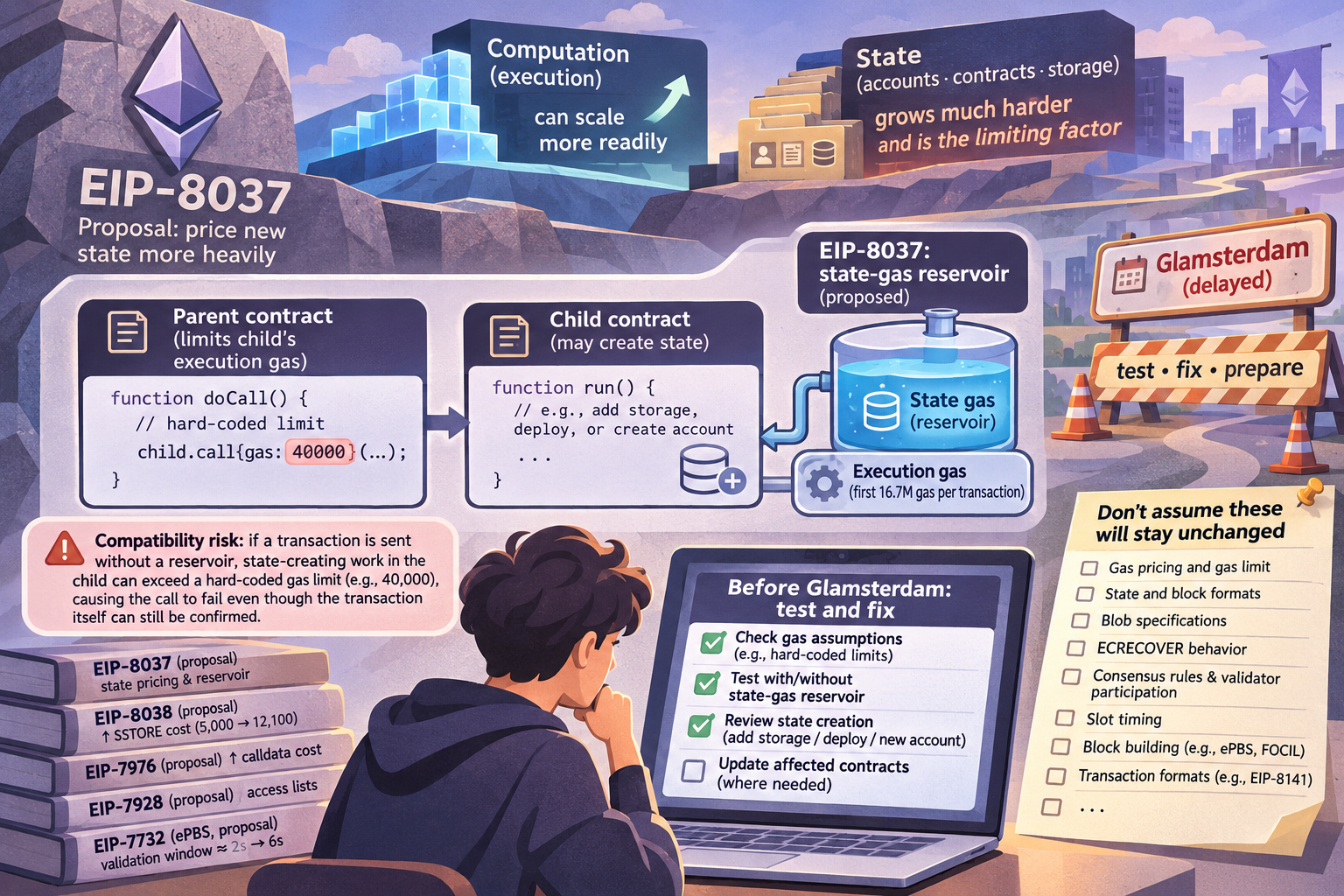
For developers of non-upgradeable contracts, his immediate lesson was not to assume that gas prices—or the ability to give a subcall less than all available gas—will remain unchanged. He called for clearer documentation of which protocol features developers should expect to change. His prospective list also covered state and block formats, blob specifications, ECRECOVER, consensus rules and validator participation, slot timing, block building and transaction formats. These were expectations about possible future changes, not a schedule of approved upgrades.