As reported on November 19, 2026, a federal judge had acquitted brothers Anton and James Peraire-Bueno over a 2023 Ethereum transaction-ordering scheme. The November 16 ruling turned on a narrow question: what, if anything, had the brothers falsely promised? It did not declare every form of maximal extractable value, or MEV, lawful.
The case also matters to staking funds. BlackRock’s prospectus for the iShares Staked Ethereum Trust ETF identifies potential MEV revenue and warns that a finding that MEV violates applicable law could disrupt the fund’s staking program.
How the bots and validators met
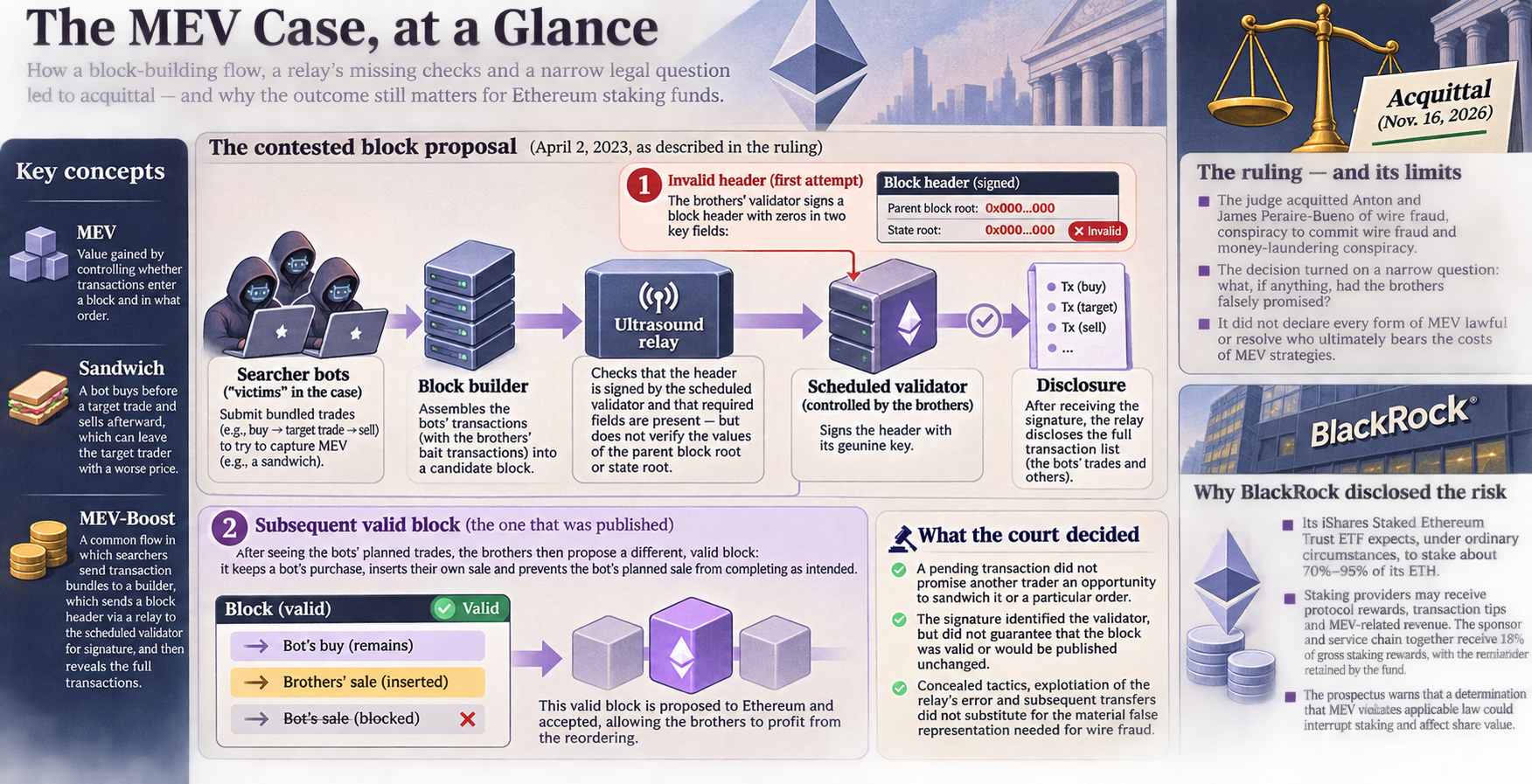
MEV is value gained by controlling whether transactions enter a block and in what order. One contested strategy is a “sandwich”: a bot buys ahead of a target trade and sells afterward, potentially leaving the target trader with a worse execution price. The three traders described as victims in this case operated bots seeking such opportunities. Their losses do not erase the costs that sandwich trading can impose on other users.
According to the court record, the brothers studied the bots from late 2022, established 16 validators and tested transactions likely to attract them. On April 2, 2023, when one of their validators was due to propose a block, they placed eight bait transactions in the public pending-transaction pool. The bots submitted bundles designed to buy before those transactions and sell afterward.
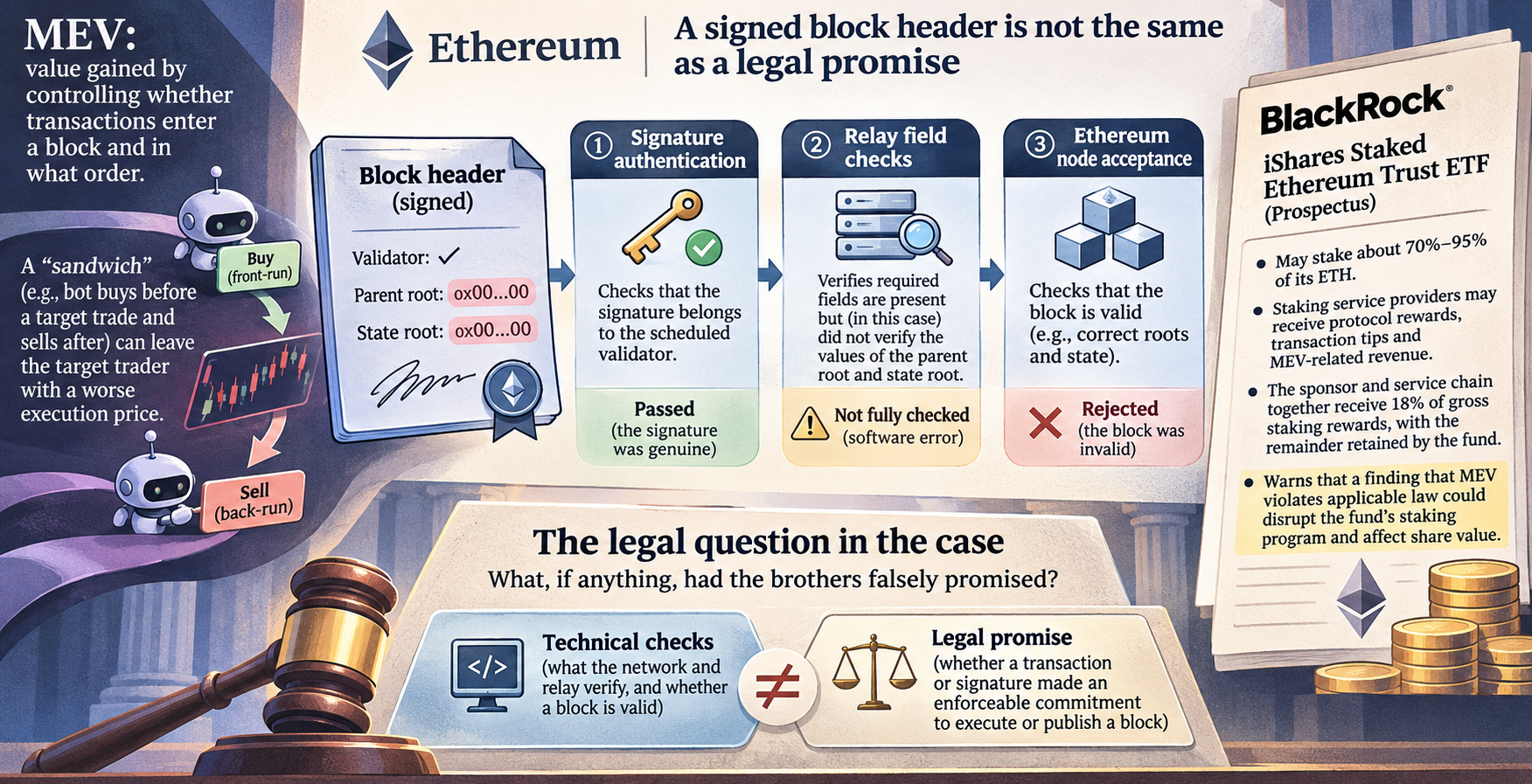
A block builder assembled transactions and sent a block header through the Ultrasound relay. Under the process described in the ruling, the proposing validator signed the header before the relay disclosed the full transaction list. The relay verified that the signature belonged to the scheduled validator and that required fields were present, but did not verify the values of two fields: the parent block root and state root.
The brothers signed a header with zeros in those fields. Its signature was genuine, but the resulting block was invalid and would be rejected by Ethereum nodes. The relay nevertheless disclosed the transaction list. The brothers then used what they had learned about the bots’ trades to propose a different, valid block: it retained a bot’s purchase, inserted their own sale and prevented the bot’s planned sale from completing as intended. Prosecutors initially described the operation as taking about $25 million in roughly 12 seconds. That figure and characterization were the prosecution’s, not an independent civil accounting of each loss by the judge.
What the acquittal decided
US prosecutors charged the brothers in May 2024 with wire fraud, conspiracy to commit wire fraud and money-laundering conspiracy. A nearly four-week trial ended without a unanimous jury verdict in 2025. Following a trial without a jury, the judge acquitted them on November 16, 2026.
The prosecution argued, in part, that the bait transactions implied they would be executed as the bots expected, and that signing the block header promised publication of the corresponding block. The judge rejected both theories. A pending transaction did not promise another trader an opportunity to sandwich it or guarantee a particular ordering. The signature identified the validator, but did not guarantee that the block was valid or would be published unchanged. The relay operator acknowledged the missing field checks were a software error.
The judge also found that concealed tactics, exploitation of that error and subsequent transfers did not substitute for the material false representation needed for the charged wire fraud. Because the money-laundering conspiracy charge in this case depended on proceeds of that alleged fraud, it failed as well. The ruling addressed these charges and facts; it was not a blanket judgment on MEV strategies.
Why BlackRock disclosed the risk
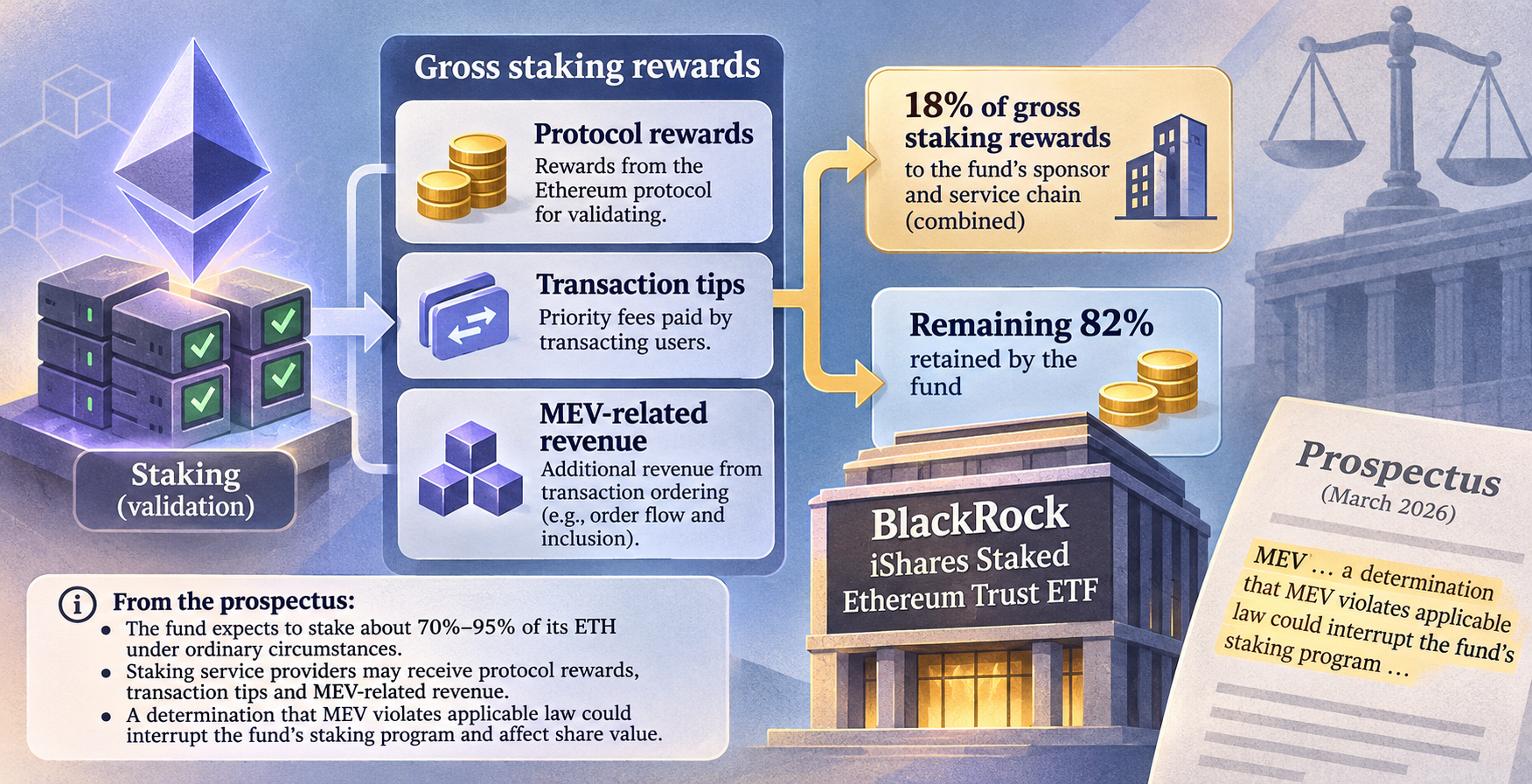
BlackRock’s March 2026 prospectus says its fund expects, under ordinary circumstances, to stake about 70%–95% of its ETH. Staking service providers may receive protocol rewards, transaction tips and MEV-related revenue. The prospectus says the sponsor and service chain together receive 18% of gross staking rewards, with the remainder retained by the fund. It warns that a determination that MEV violates applicable law could interrupt staking and affect share value.
That disclosure does not say the fund runs sandwich bots or took part in the brothers’ relay exploit. It does show why the legal treatment of transaction-ordering revenue matters to a product that may receive a share of it. The prospectus also describes contractual obligations involving Coinbase and validators, including anti-money-laundering controls, sanctions-address screening and periodic testing, while warning that failures and resulting losses may still affect the fund and its holders.
The case separates three questions that can otherwise blur together: whether a signed header passes a relay’s checks, whether a validator has made an enforceable commitment, and whether particular conduct satisfies the elements of a criminal charge. The acquittal answered the last question on this record; it did not resolve who ultimately bears the costs of every MEV strategy.